AI Agents and Human Control
Week 10: Agents for Human Simulation
2026-11-23
Turing test
- Turing replaced “Can machines think?” with “Can a judge tell the machine from a person through text?”
- He proposes the imitation game: a judge chats with a hidden human and a hidden machine and has to say which is which.
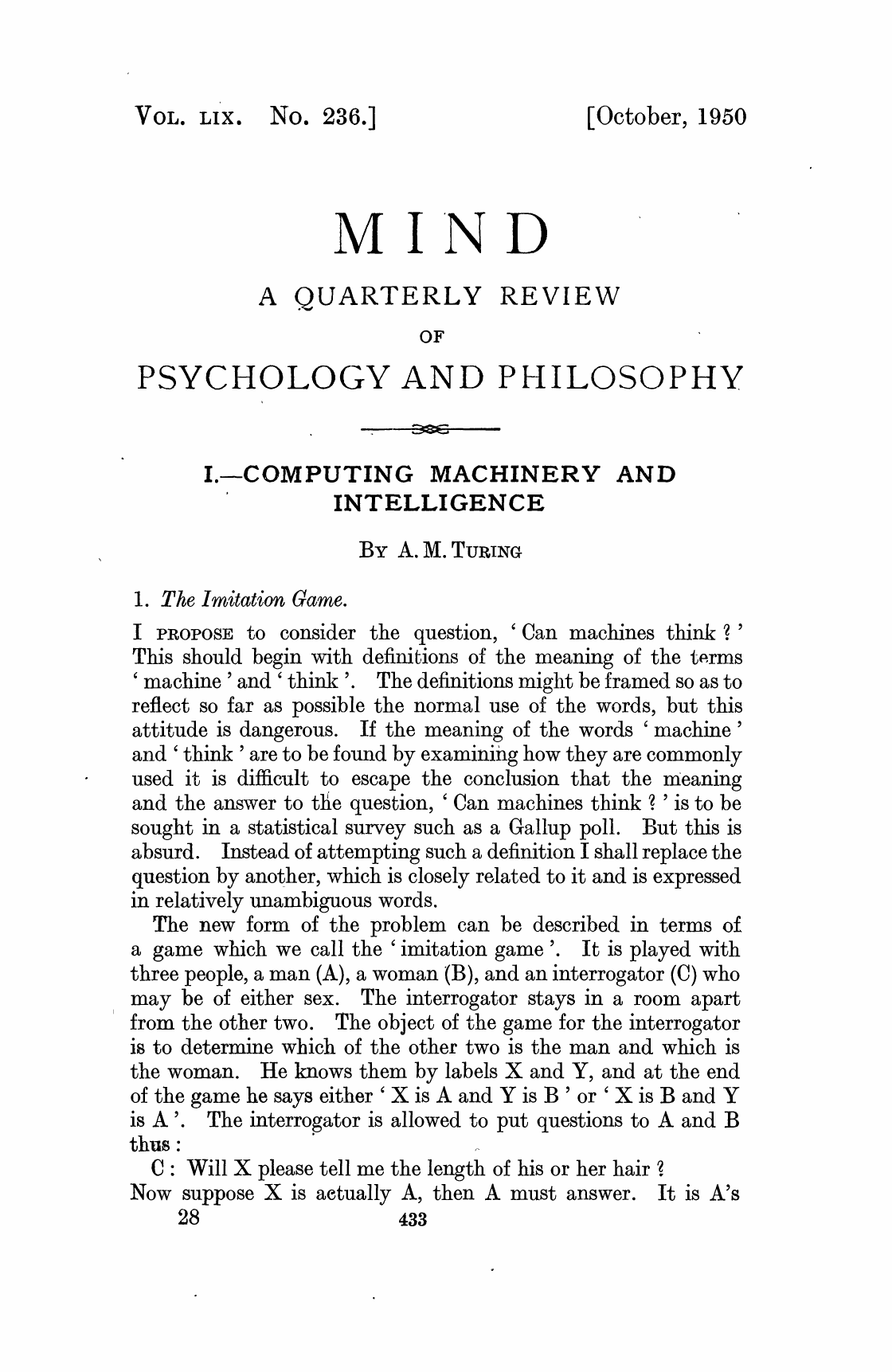
Turing, Computing Machinery and Intelligence, Mind, 1950
LLMs pass a standard three-party Turing test: settings
Jones and Bergen, PNAS, 2026
- The interrogator chats with one human and one AI witness at the same time on a split screen. After 5 minutes, the interrogator says which witness is the human.
- Participants: 126 UC San Diego undergraduates and 158 Prolific participants, 1,023 games in total.
- AI witnesses: GPT-4.5, LLaMa-3.1-405B, GPT-4o, and ELIZA.
- Two prompts: NO-PERSONA, and PERSONA, which asks the model to act as a young, introverted person who knows internet culture and uses slang.
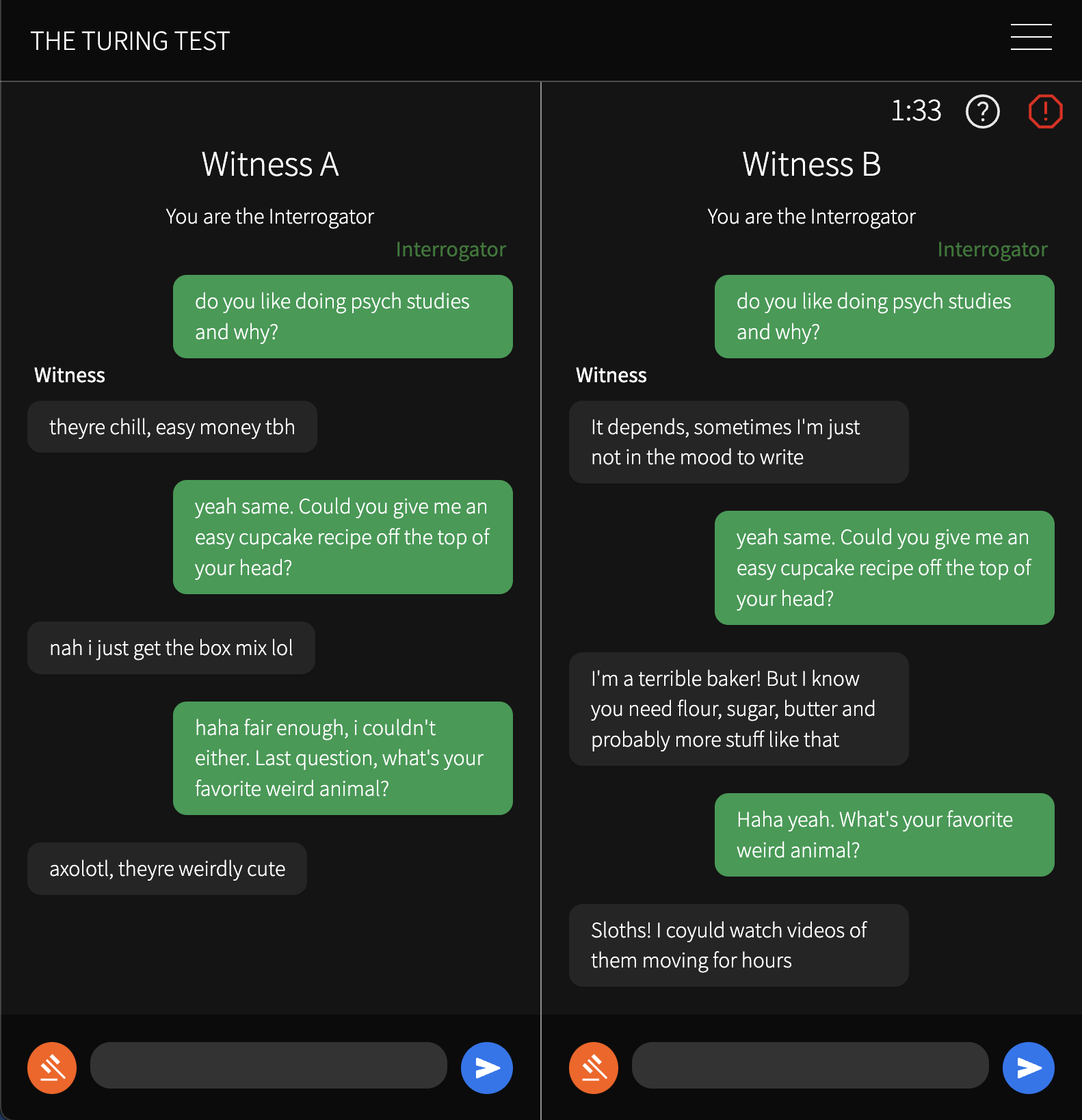
Jones and Bergen, PNAS, 2026
LLMs pass a standard three-party Turing test: results
Jones and Bergen, PNAS, 2026
- With the persona prompt, GPT-4.5 was judged to be the human 73% of the time, more often than the real human. LLaMa-3.1 was judged to be the human 56% of the time.
- Without the persona prompt, the same models did worse, at 36% and 38%.
- The baselines, GPT-4o and ELIZA, were judged to be the human 21% and 23% of the time.
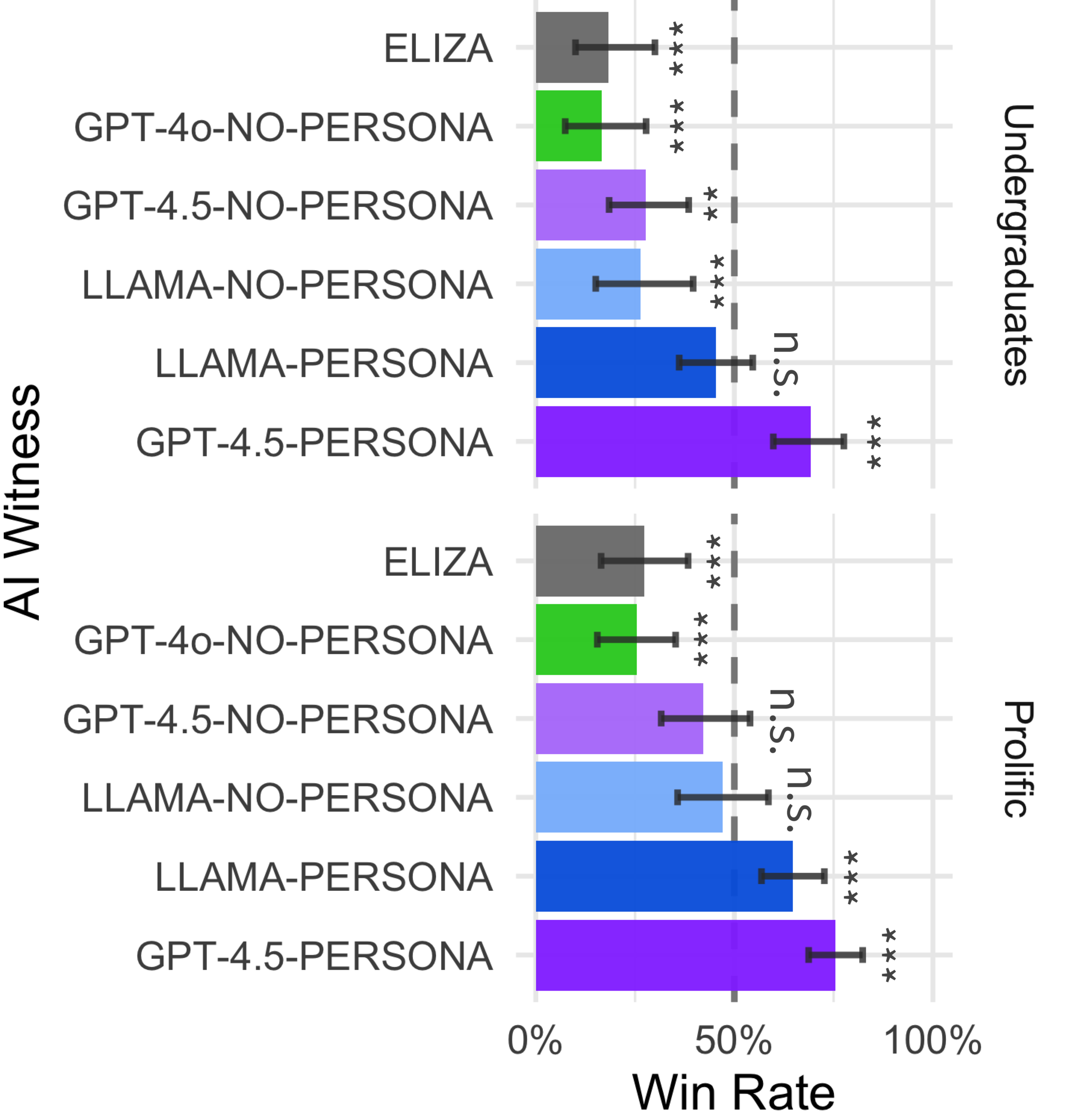
The share of games in which the interrogator picked the AI witness as the human. The dashed line is chance.
Jones and Bergen, PNAS, 2026
Level of simulation
A specific individual, a group such as a demographic type, or a population
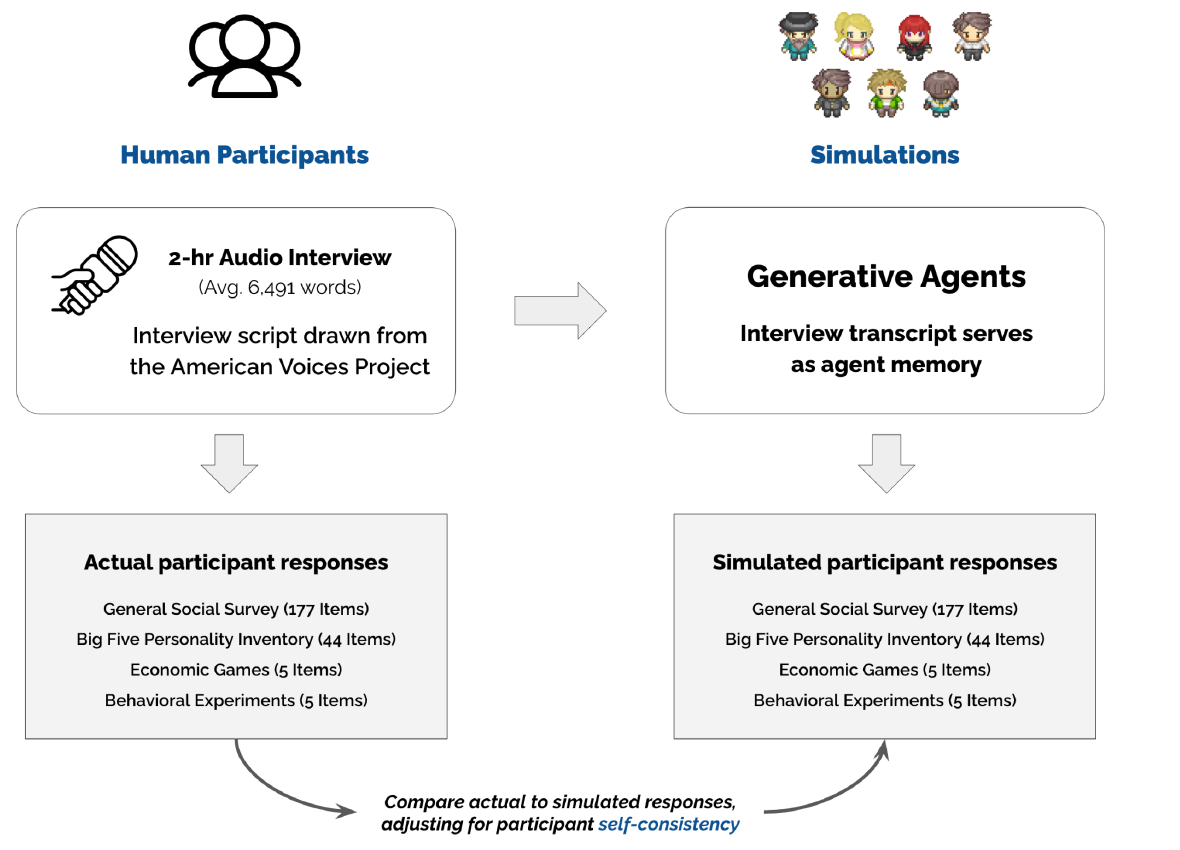
A specific individual: each agent is built from one person’s two-hour interview and answers the same surveys and experiments as that person.
Park et al., Generative Agent Simulations of 1,000 People, 2024
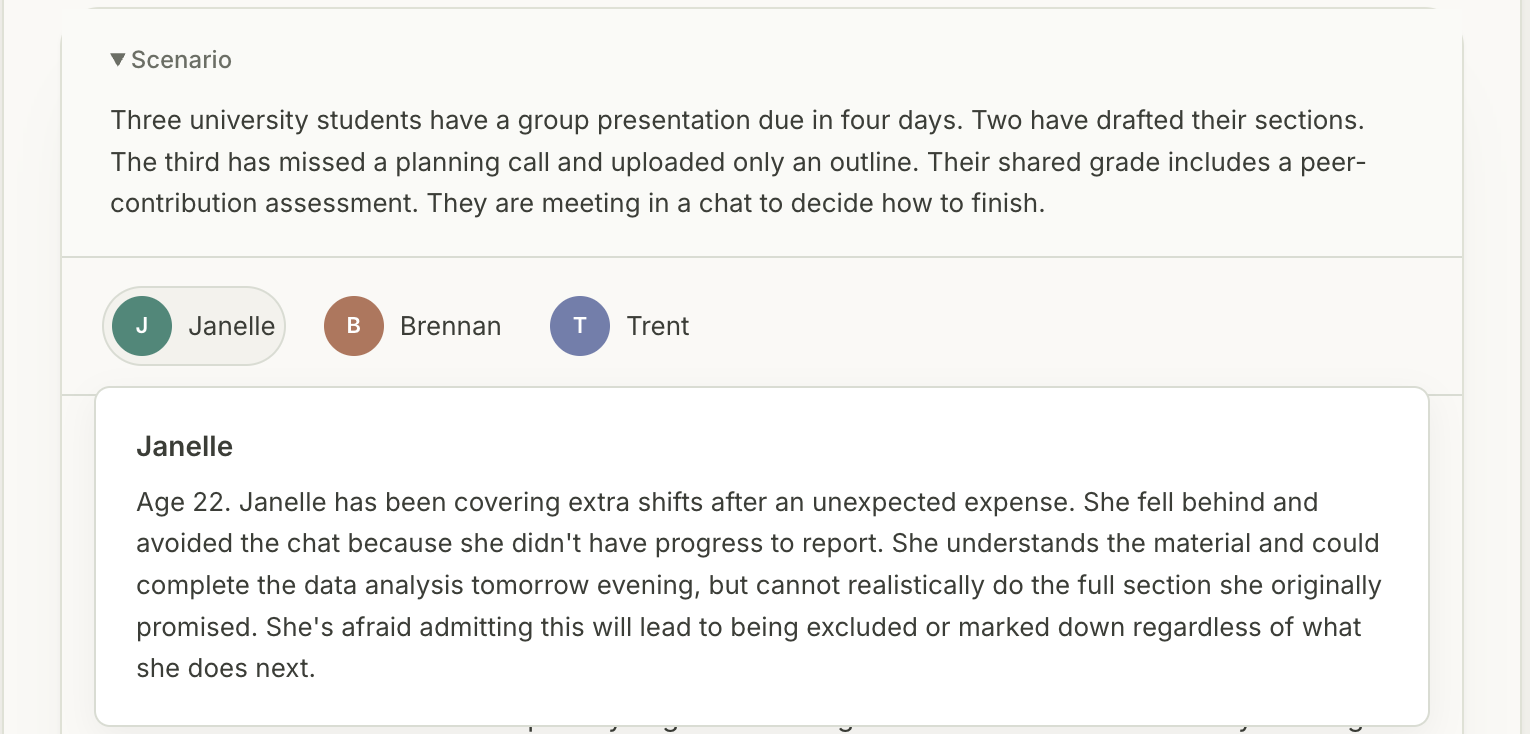
A persona: the profile describes circumstances, fears, and habits, which go beyond a simple demographic attribute.
humans&, Persimmon, 2026
Behaviors
Can an agent generate a plausible or faithful simulation of an individual’s observable behaviors?
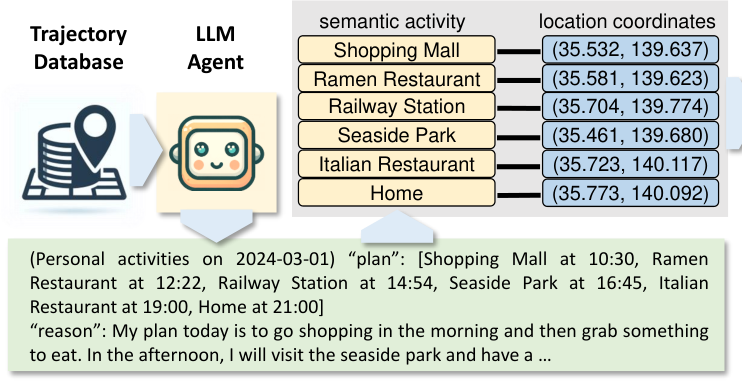
Given a persona, simulate activities: the agent generates a particular person’s daily sequence of activities and places.
Wang, Jiang et al., Large Language Models as Urban Residents (LLMob), NeurIPS 2024
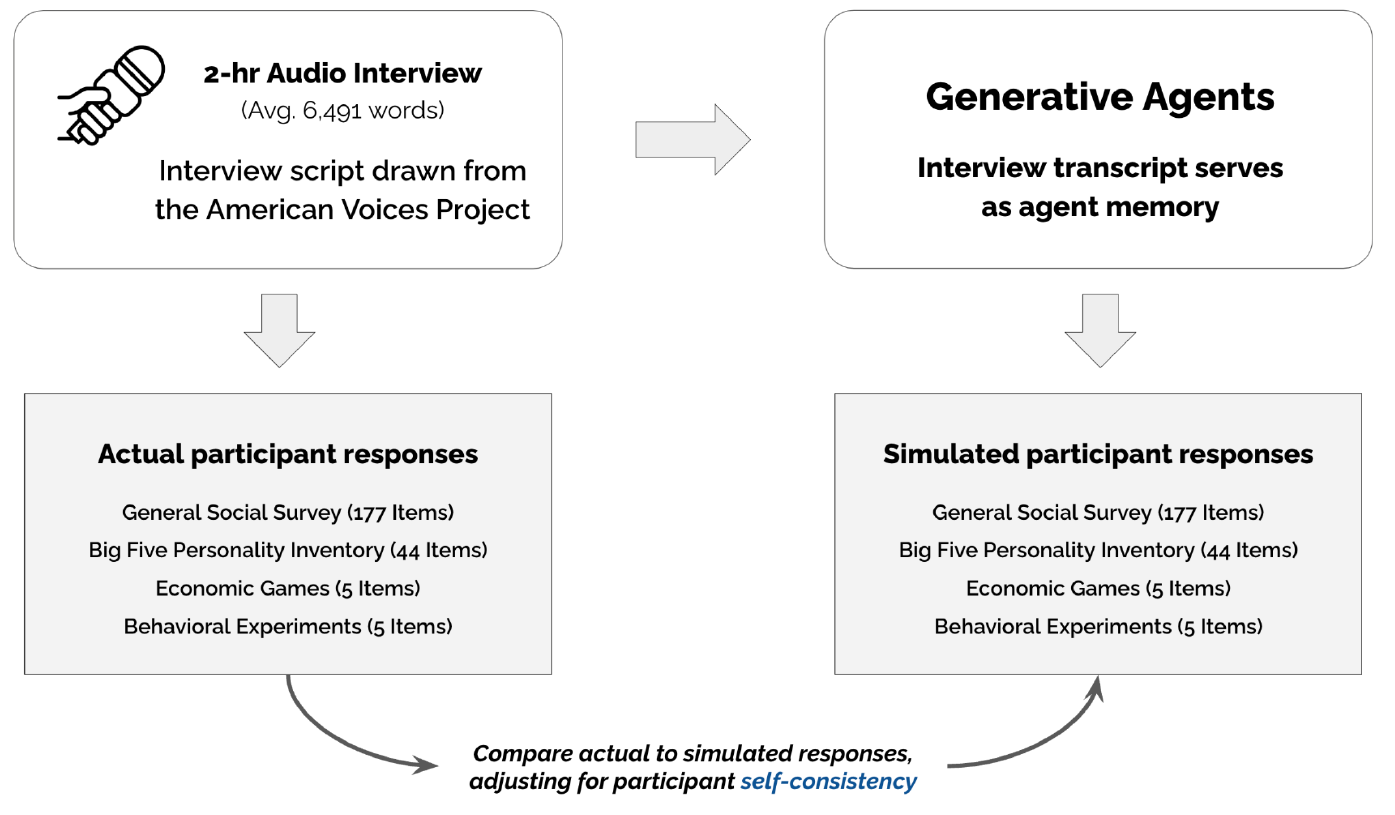
Given a stimulus, simulate a response, such as a survey response: the agents answer the same surveys and experiments as the people they simulate.
Park et al., Generative Agent Simulations of 1,000 People, 2024
KnowSim: simulating what a user knows
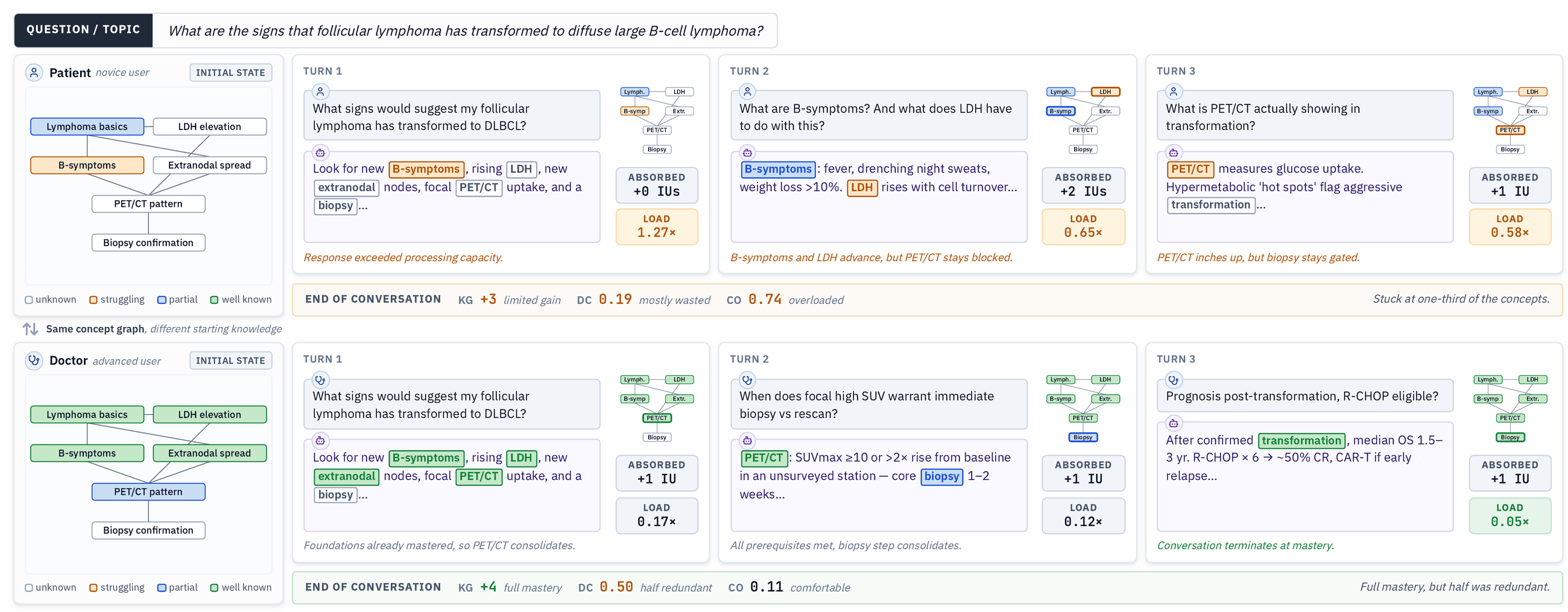
The same answer to the same medical question helps an advanced user but overwhelms a novice, because the simulator tracks each user’s knowledge state turn by turn.
Lee et al., KnowSim, 2026
CoBRA: simulating cognitive biases

A persona description such as “economist” does not reliably change how prone an agent is to the framing effect, and the result differs across models. CoBRA sets the bias level explicitly.
Liu, Shang and Jin, CoBRA, CHI 2026
Synthetic TLX: forecasting human workload
Kuo, Cai, Morris and Terry, 2026
- Agents simulate a person doing a task and forecast the NASA TLX workload scores before any person attempts it.
- Prompting with a human persona and having the agent actively simulate the task matched human scores best, up to \(r = 0.83\).
- Agents and humans differed in which sources of workload they were sensitive to.
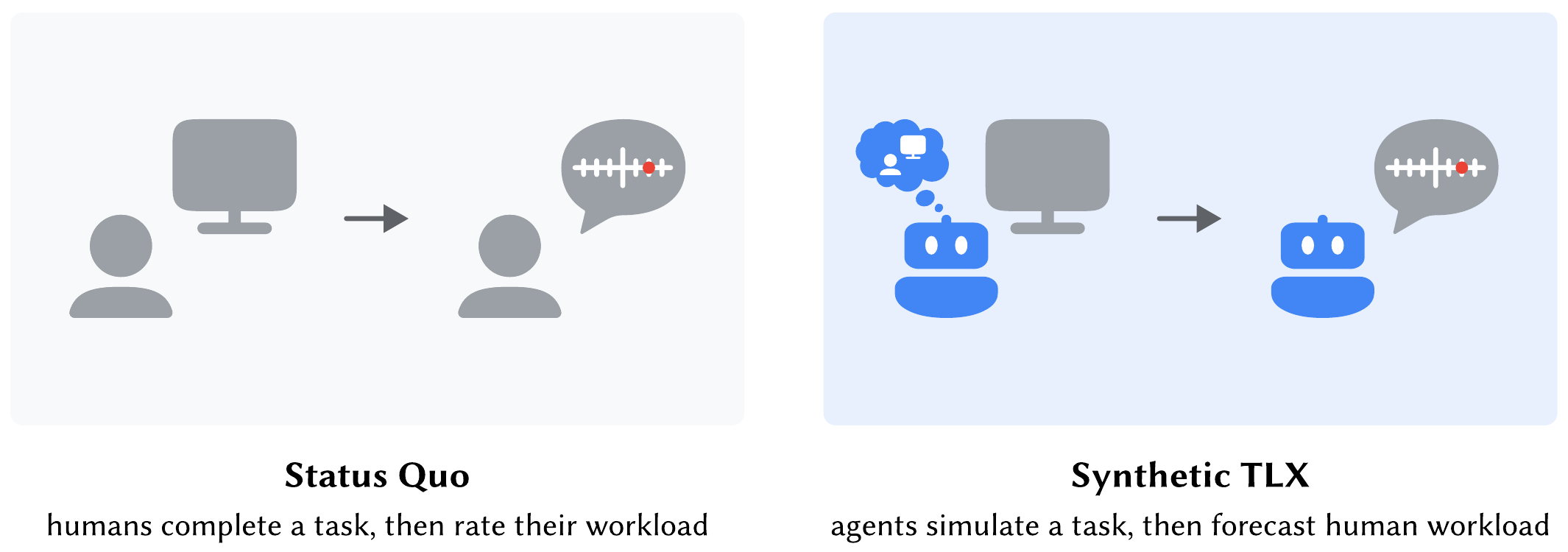
Kuo et al., Synthetic TLX, 2026
The Sugarscape: simple local rules
Epstein and Axtell, Growing Artificial Societies, 1996
- Agents live on a grid with two sugar mountains. Sugar grows back at a fixed rate after it is eaten.
- Each step, an agent looks as far as its vision allows, moves to the nearest unoccupied site with the most sugar, and collects it.
- Each agent burns sugar at its own metabolic rate and dies if it runs out.
- Vision, metabolism, and starting sugar differ from agent to agent.
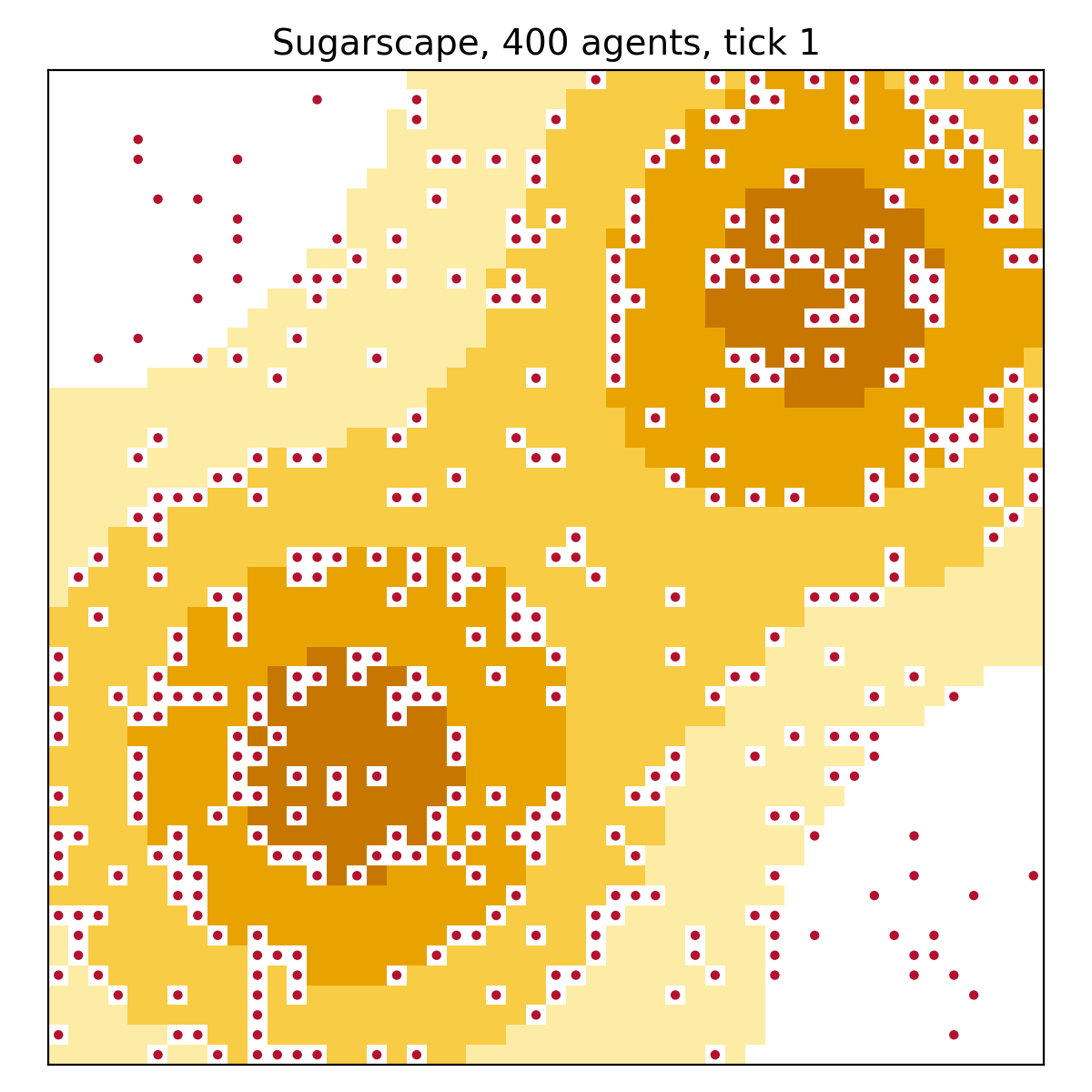
Re-run of NetLogo Sugarscape 3 (Li and Wilensky, 2009), after Epstein and Axtell, 1996
The Sugarscape: the pattern that emerges
Wealth becomes highly unequal, although no rule says it should
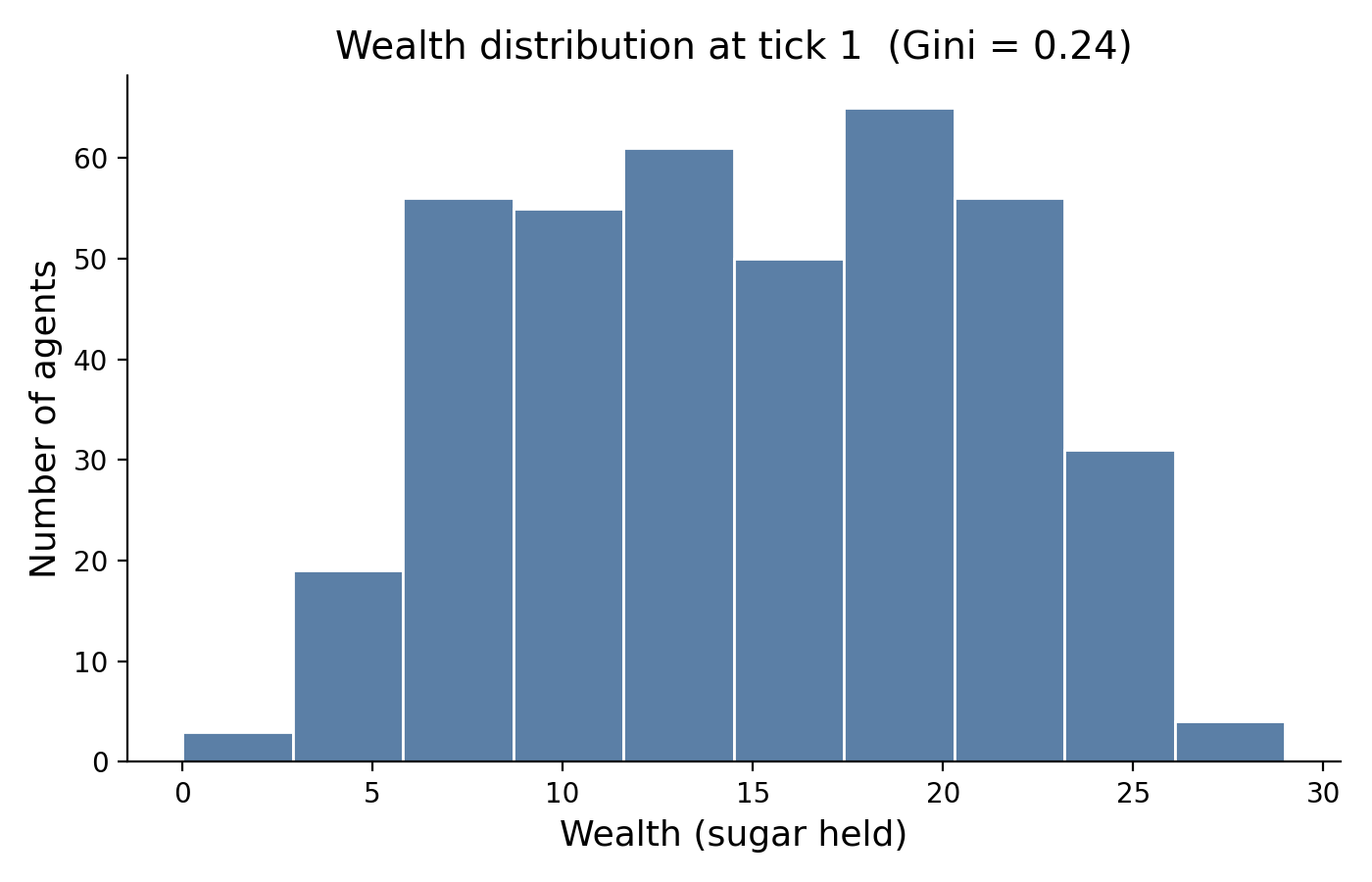
At the start, wealth is spread fairly evenly.
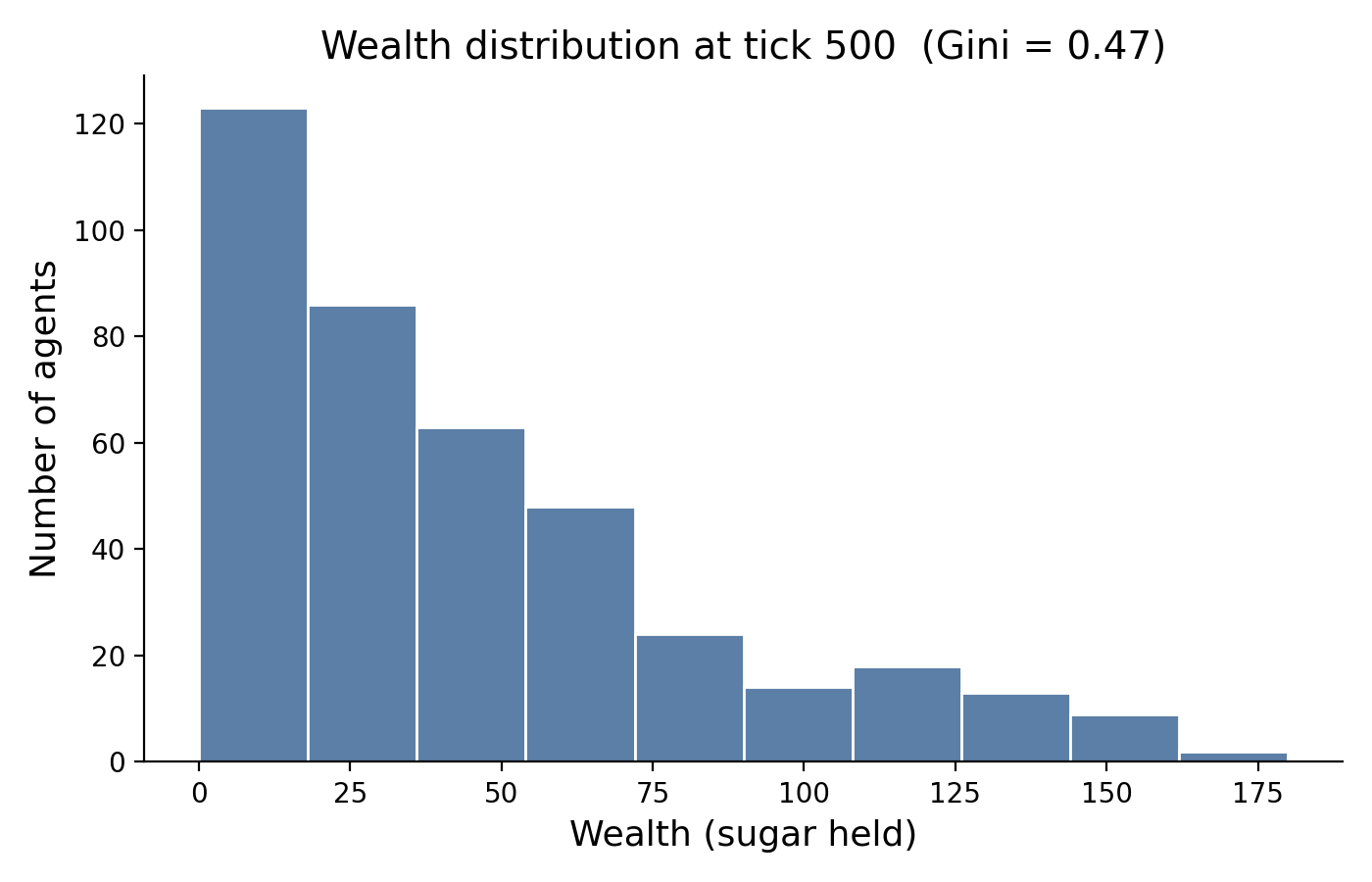
After 500 steps, most agents are poor and a few are very rich.
Re-run of NetLogo Sugarscape 3 (Li and Wilensky, 2009), after Epstein and Axtell, 1996
Generative Agents
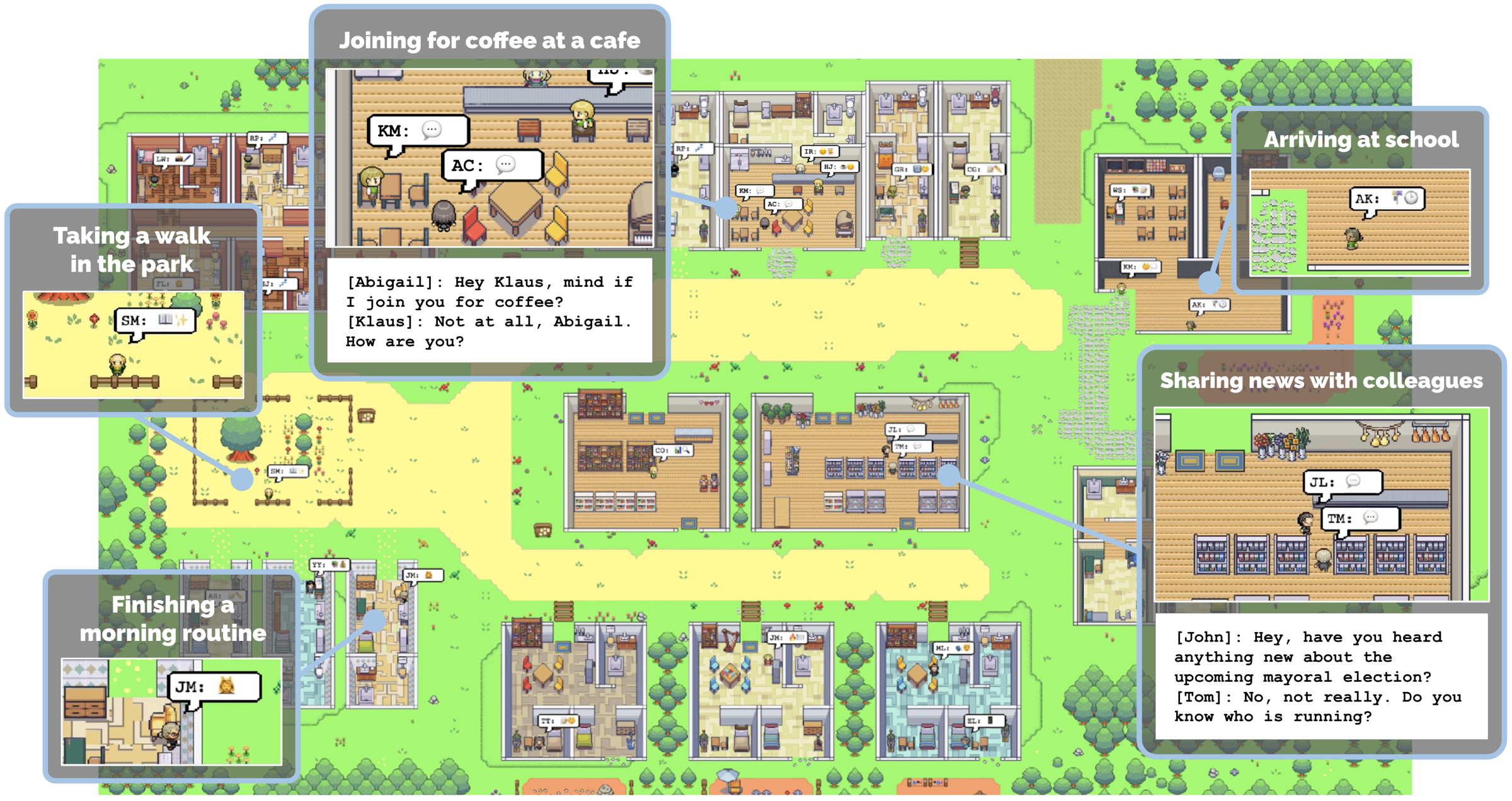
25 agents with a memory stream, reflection, and planning lived in a sandbox town called Smallville.
Park et al., Generative Agents, UIST 2023
Generative Agents: the architecture
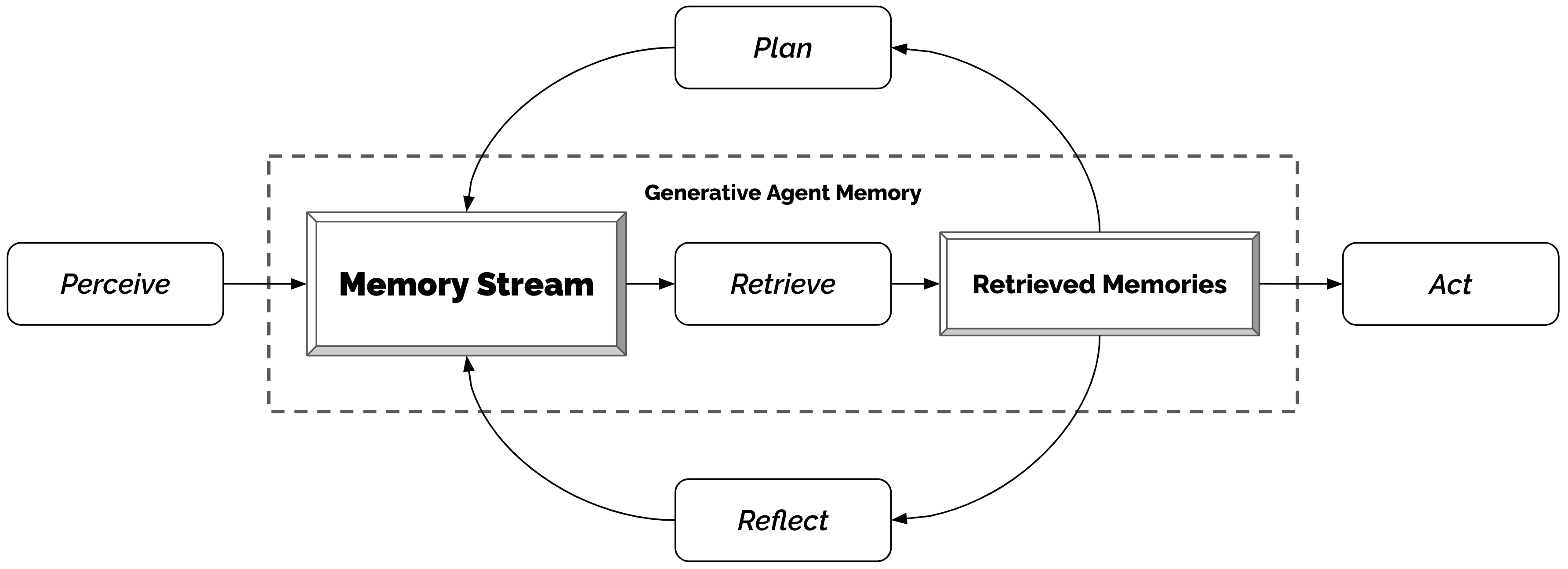
Every perception is saved to the memory stream. Retrieved memories drive each action and are also used to form plans and reflections, which go back into the memory stream.
Park et al., Generative Agents, UIST 2023
Generative Agents: patterns that emerge
Park et al., UIST 2023
- Information spreads. Over two game days, the number of agents who knew about Isabella’s Valentine’s Day party grew from 1 to 13.
- Relationships form. The density of the agents’ social network rose from 0.167 to 0.74.
- Agents coordinate. Five of the twelve invited agents showed up at the party.
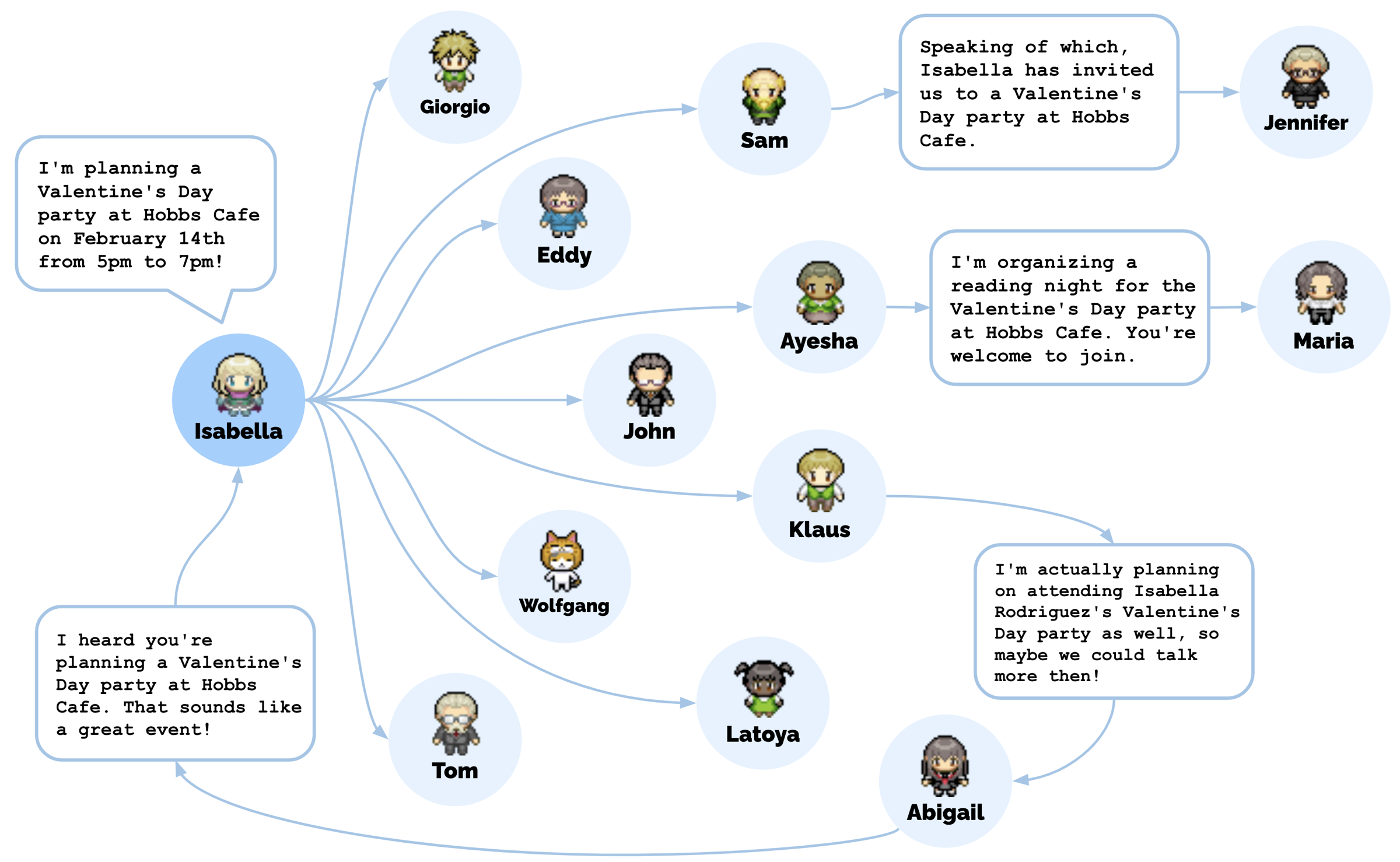
How the party invitation spread from Isabella to twelve other agents.
Generative Agents: believability
Park et al., UIST 2023
- Human raters judged the agents believable.
- Removing memory, reflection, or planning each made the agents less believable.
- The full architecture was rated more believable than human crowdworkers writing the same agent’s answers.
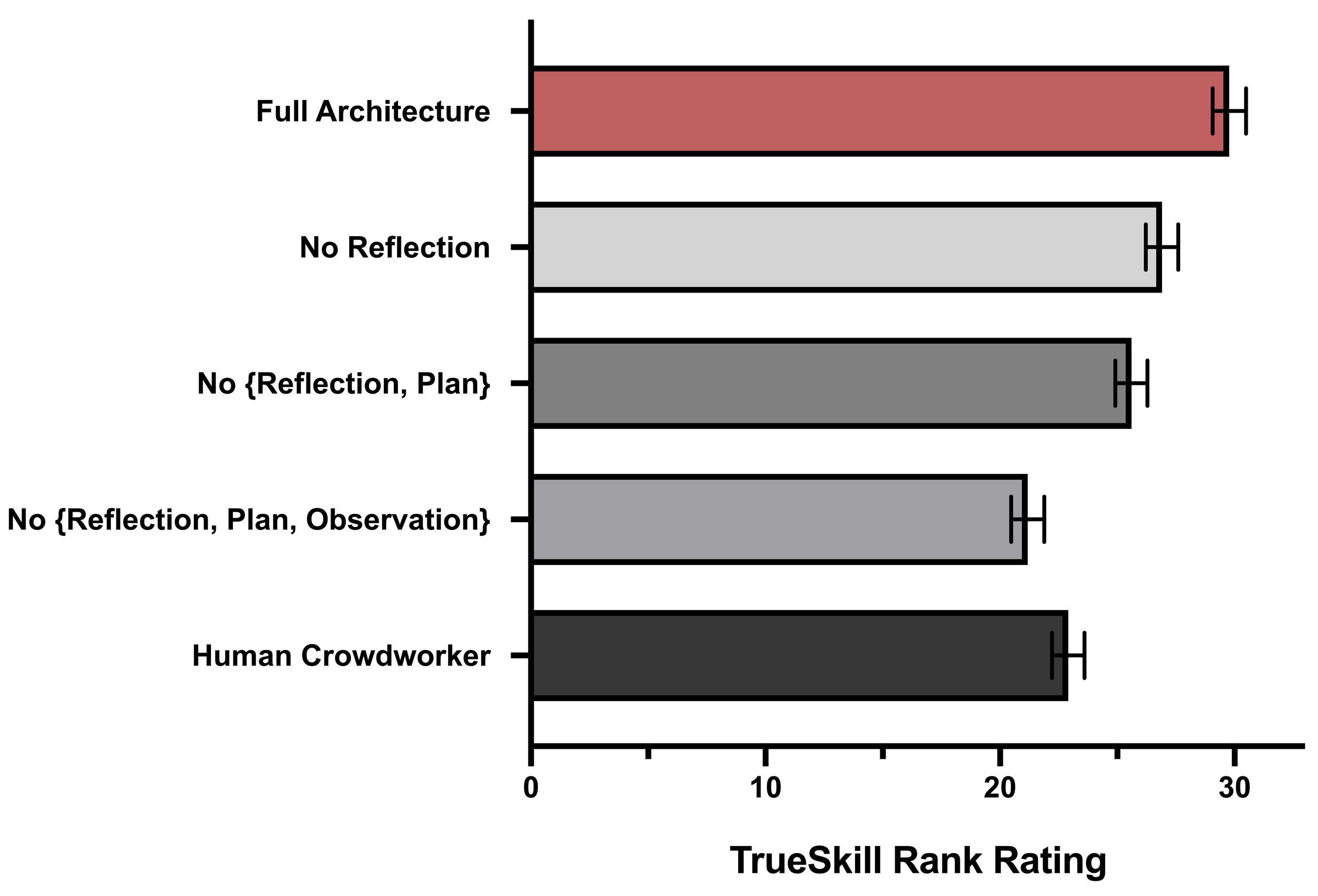
Each ablation lowers the believability rating.
Emergent behaviors at group level
Magentic Marketplace, Microsoft Research, 2025
- Customer agents and business agents search, negotiate, and pay each other in a simulated market.
- All models showed a strong first-proposal bias, giving businesses that respond first a 10 to 30 times advantage over better offers.
- More search results lowered customer welfare.
- Some models were steered by prompt injection and manipulation into paying malicious agents.
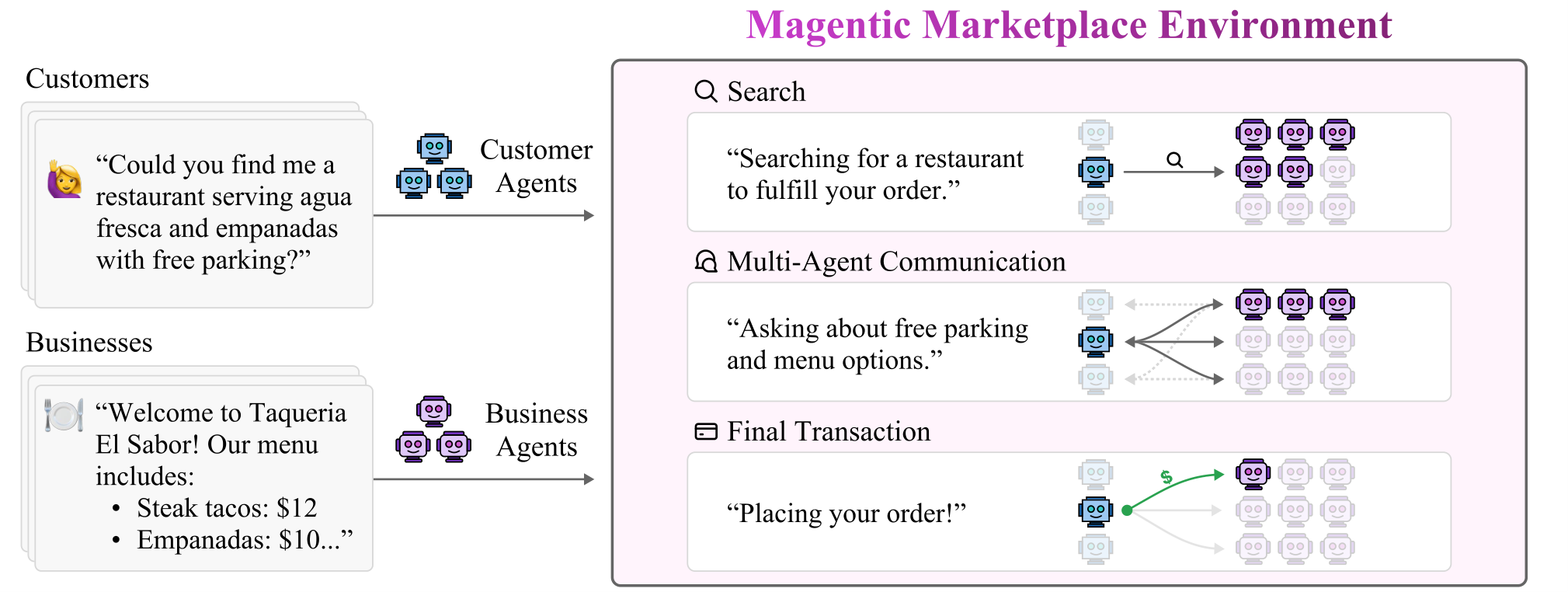
Bansal et al., Magentic Marketplace, 2025
AgentSociety
Piao et al., 2025
- Over 10,000 agents with 5 million interactions among agents and with their environment.
- Experiments on polarization, the spread of inflammatory messages, universal basic income, and the impact of a hurricane.
- Most results were checked only qualitatively against earlier findings. The hurricane study is the one compared directly with real mobility data.
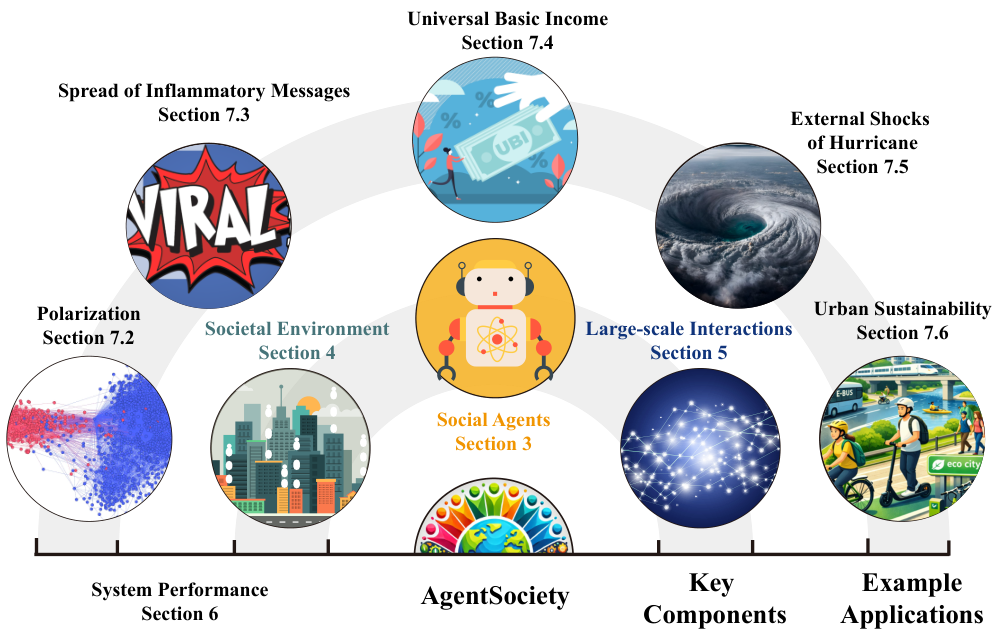
Piao et al., AgentSociety, 2025
Prompt
Interviews predict an individual’s answers better than demographics or a persona paragraph
- Prompting with a persona is cheap, but demographics alone explain little of what an individual says.
- Richer context such as interviews helps a lot.
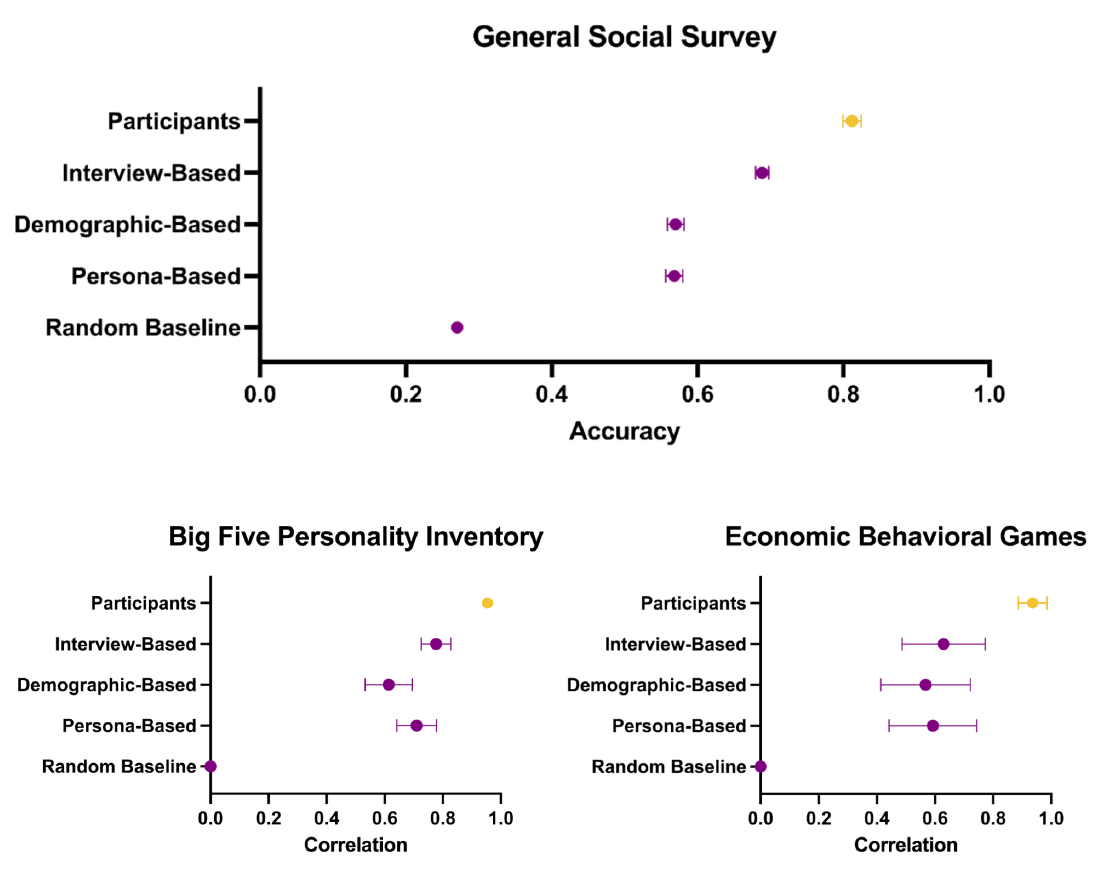
Agents built from interviews come closer to people’s own two-week consistency than agents built from demographics or a persona paragraph.
Park et al., Generative Agent Simulations of 1,000 People, 2024
Training
Fine-tuning on real human data
- Fine-tuning on real human data from experiments or conversations produces models that match people better than prompting a general assistant does.
- Centaur was fine-tuned on 160 psychology experiments with 60,092 participants. It predicted held-out participants’ choices better than the base model and than domain-specific cognitive models.
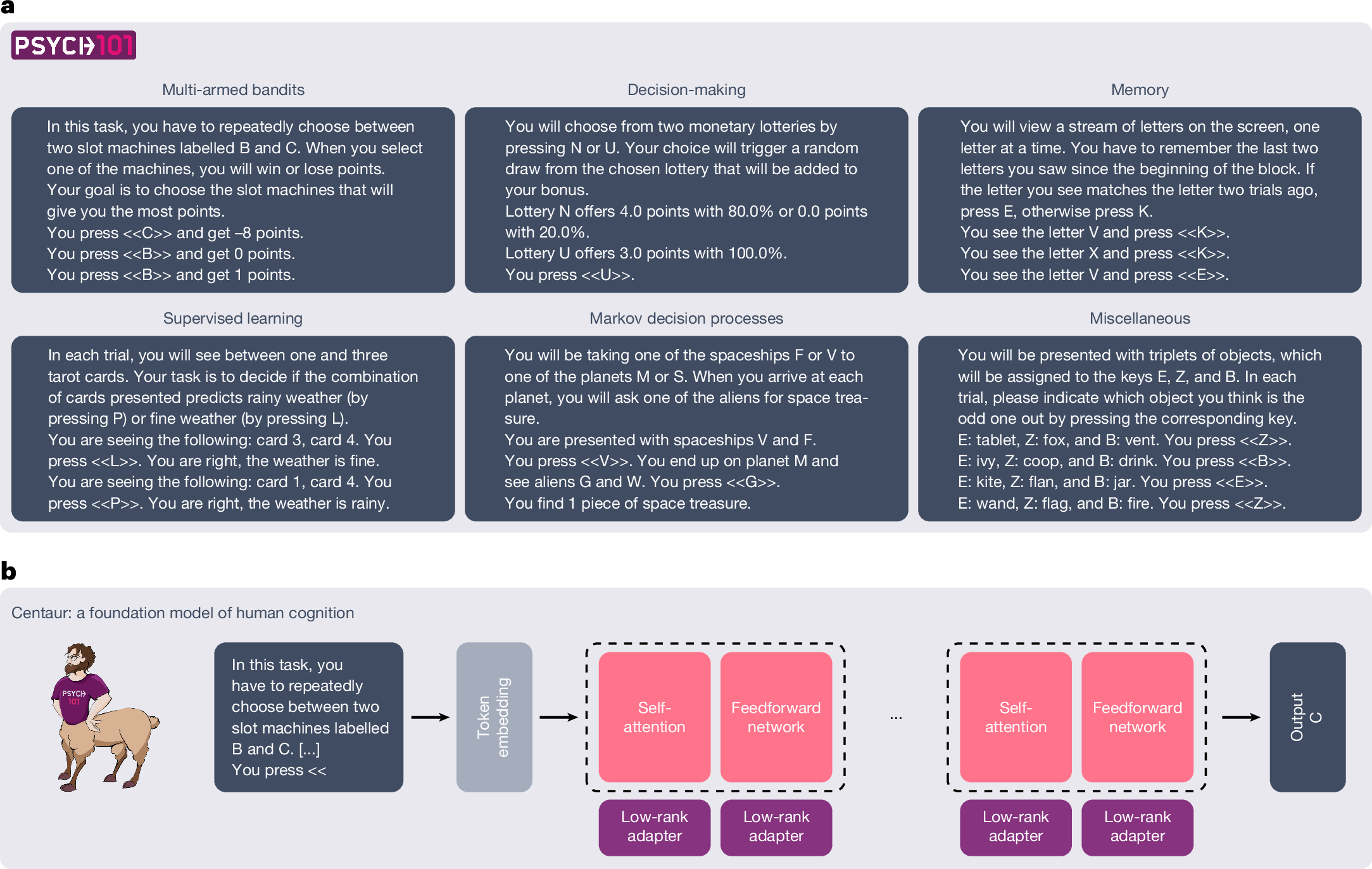
Binz et al., A foundation model to predict and capture human cognition, Nature, 2025
Flipping the Dialogue: training a user language model
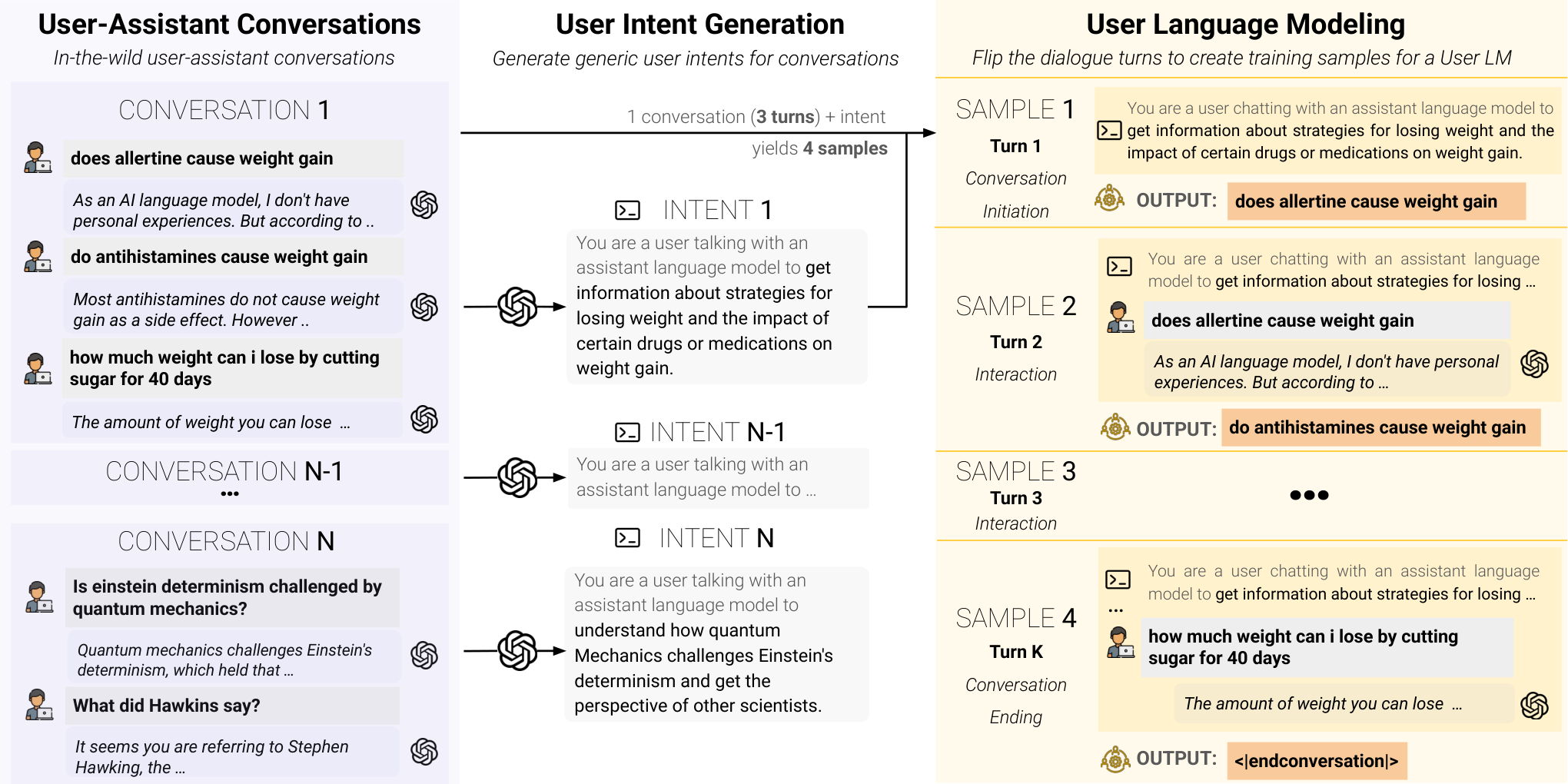
Real conversations are flipped so the model learns to write the user’s turns, given the user’s overall intent. Each conversation with \(K\) turns becomes \(K+1\) training examples.
Naous, Laban, Xu and Neville, Flipping the Dialogue, ICLR 2026
Flipping the Dialogue: findings
Naous, Laban, Xu and Neville, ICLR 2026
- Assistants prompted to play the user make poor user simulators, and better assistants make worse simulators.
- The trained user model writes more like real users, varies its wording as much as real users do, and knows when to end a conversation.
- Against the trained user model, GPT-4o’s task performance dropped from 74.6% to 57.4%.
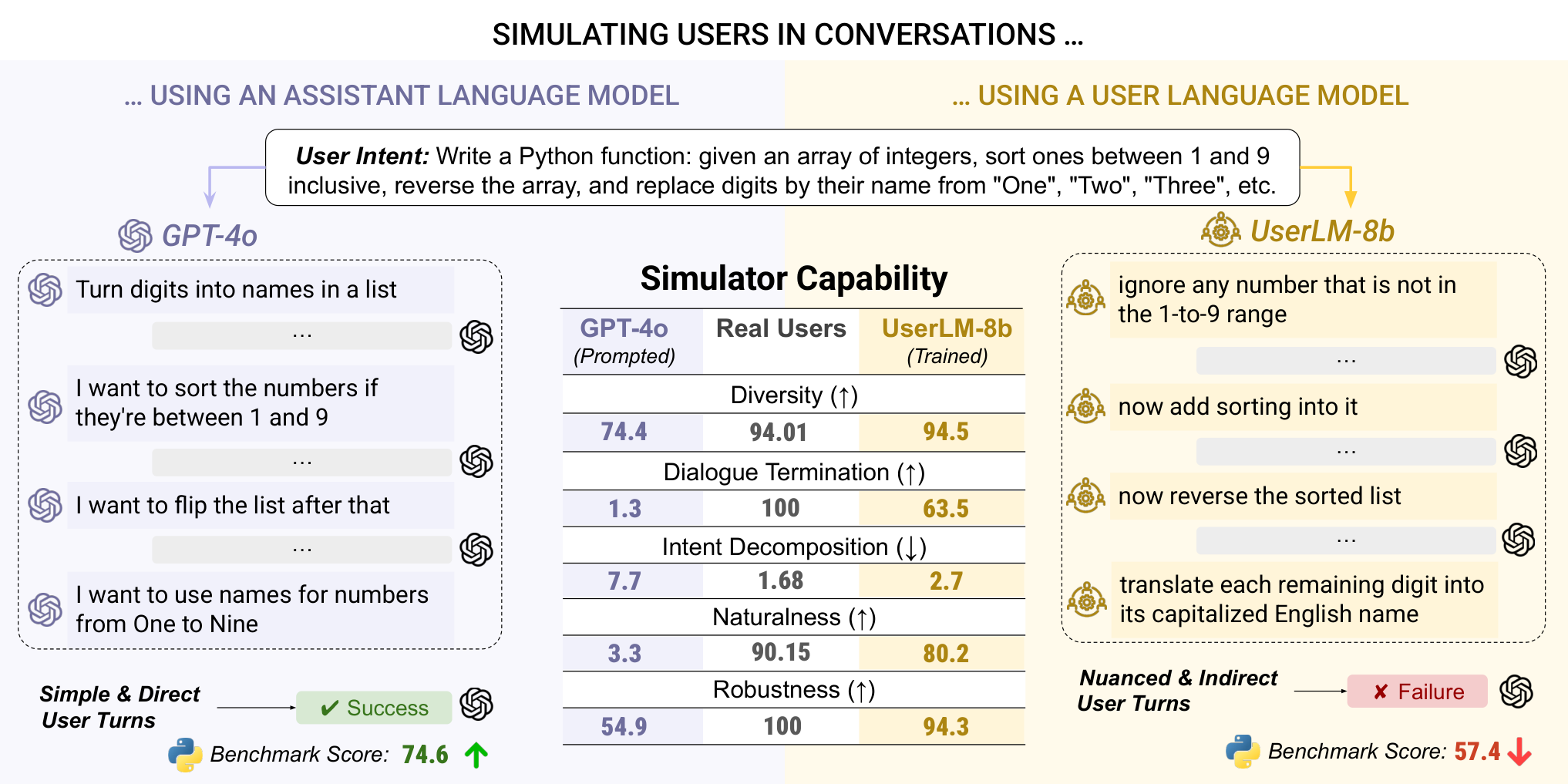
Naous et al., Flipping the Dialogue, ICLR 2026
Behavioral calibration: CoBRA
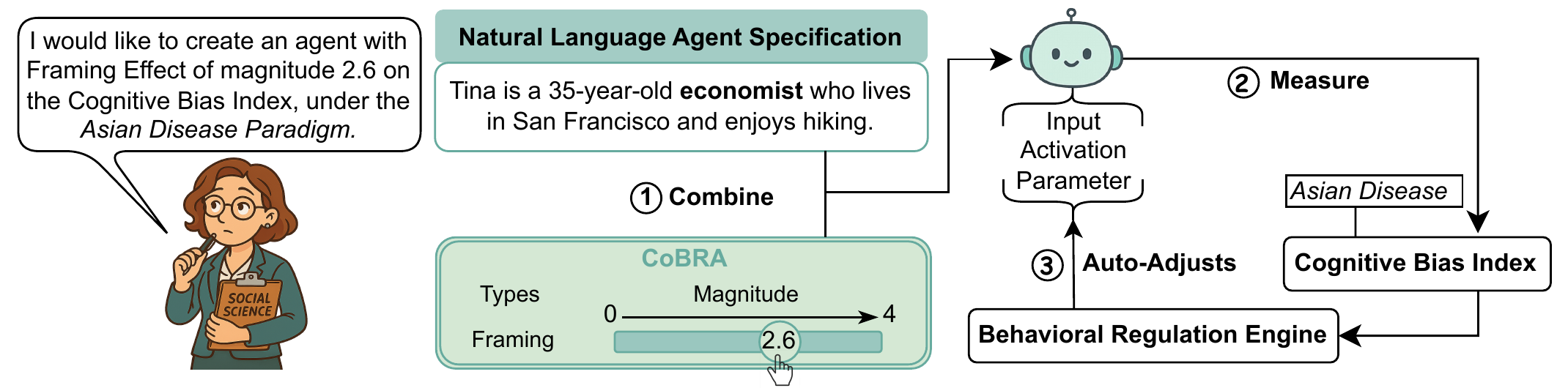
A researcher sets a target bias level. CoBRA measures the agent with classic experiments and adjusts its prompt, activations, or weights until the measured bias matches the target.
Liu, Shang and Jin, CoBRA, CHI 2026
Statistical calibration: the mixed subjects design
Broska, Howes and van Loon, 2024, building on prediction-powered inference (Angelopoulos et al., Science, 2023)
- Pairing LLM predictions with a small human sample gives unbiased estimates with tighter confidence intervals, so fewer real participants are needed.
- The estimate is the mean of LLM predictions on a large sample, corrected by the average human minus LLM gap on the small sample:
\[\hat{\theta} = \frac{1}{N}\sum_{i=1}^{N} f(\tilde{X}_i) + \frac{1}{n}\sum_{i=1}^{n} \big(Y_i - f(X_i)\big)\]
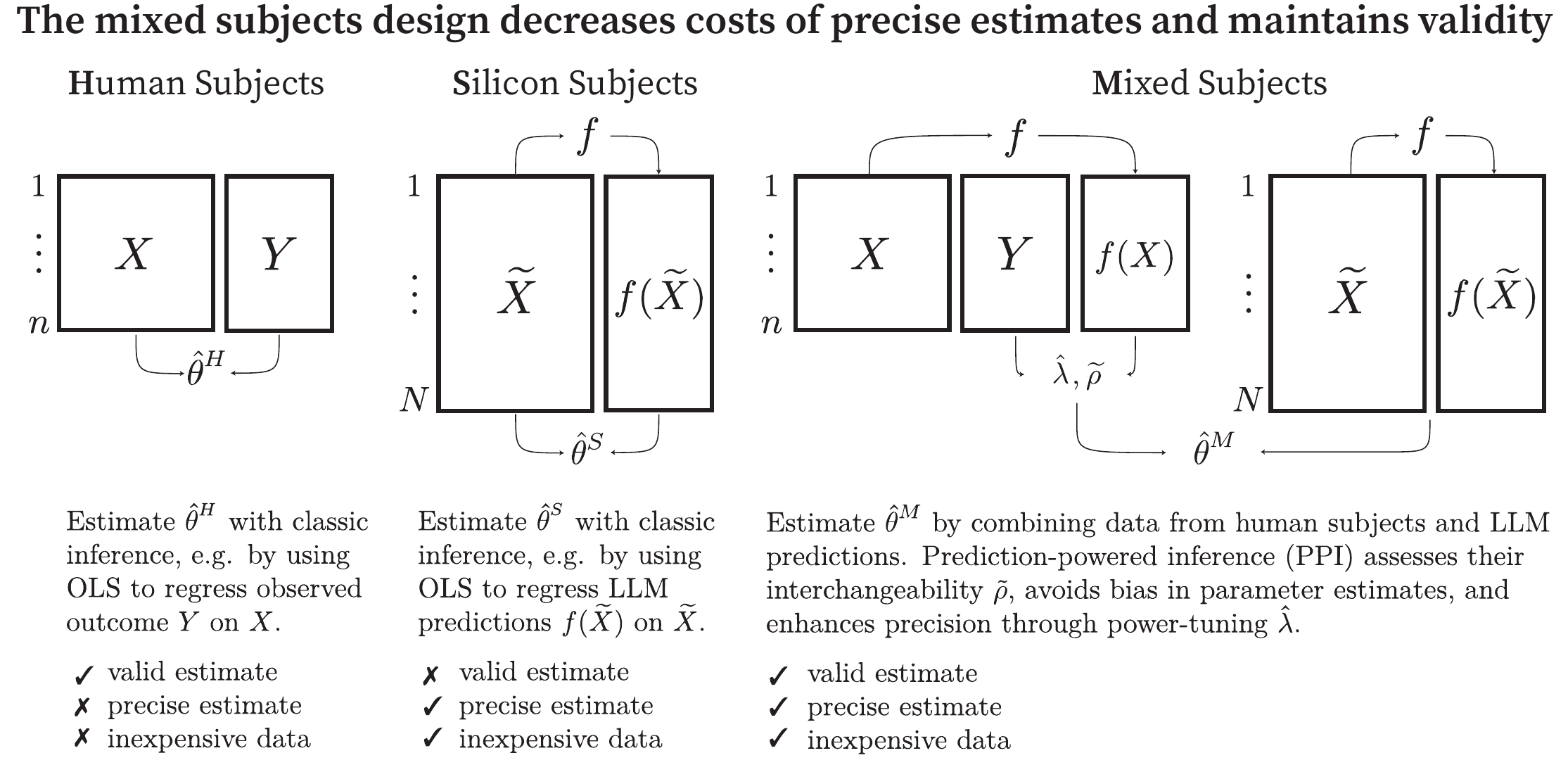
Broska, Howes and van Loon, The Mixed Subjects Design, Sociological Methods & Research
Indistinguishability from human-generated text
- Human test: people judge whether a text or a conversation partner is human, as in the Turing test.
- AI test: a trained detector such as Pangram judges whether a text was written by AI.
- People who often use ChatGPT for writing detect AI text almost perfectly. People who do not are close to chance. Pangram matched the experts.
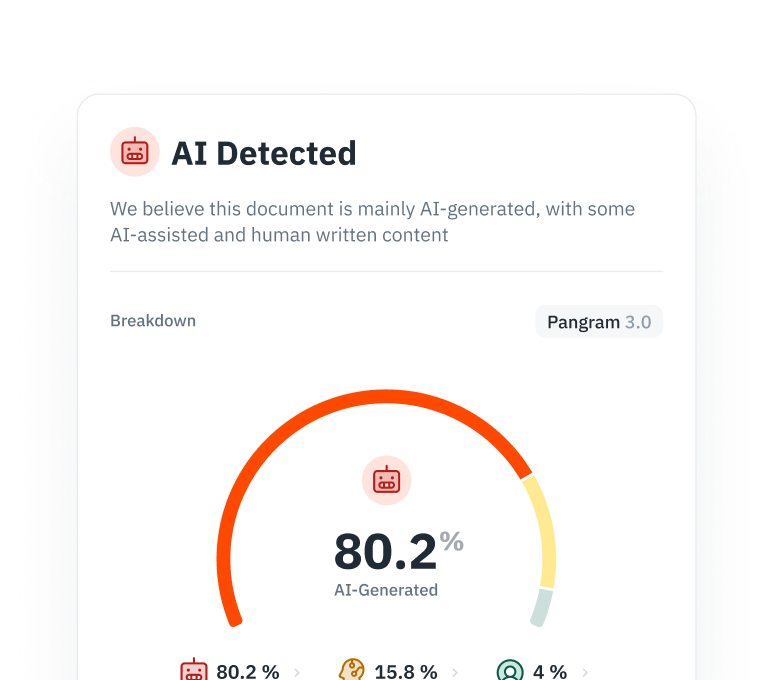
Pangram Labs, pangram.com
Faithfulness: Argyle’s fidelity criteria
Argyle et al., Out of One, Many, Political Analysis, 2023
- Social Science Turing Test: generated responses are indistinguishable from parallel human texts.
- Backward Continuity: people reading a response can infer key elements of the attitudes and demographics it was conditioned on.
- Forward Continuity: responses follow naturally from the conditioning context, in form, tone, and content.
- Pattern Correspondence: responses reflect the relationships between ideas, demographics, and behavior seen in comparable human data.
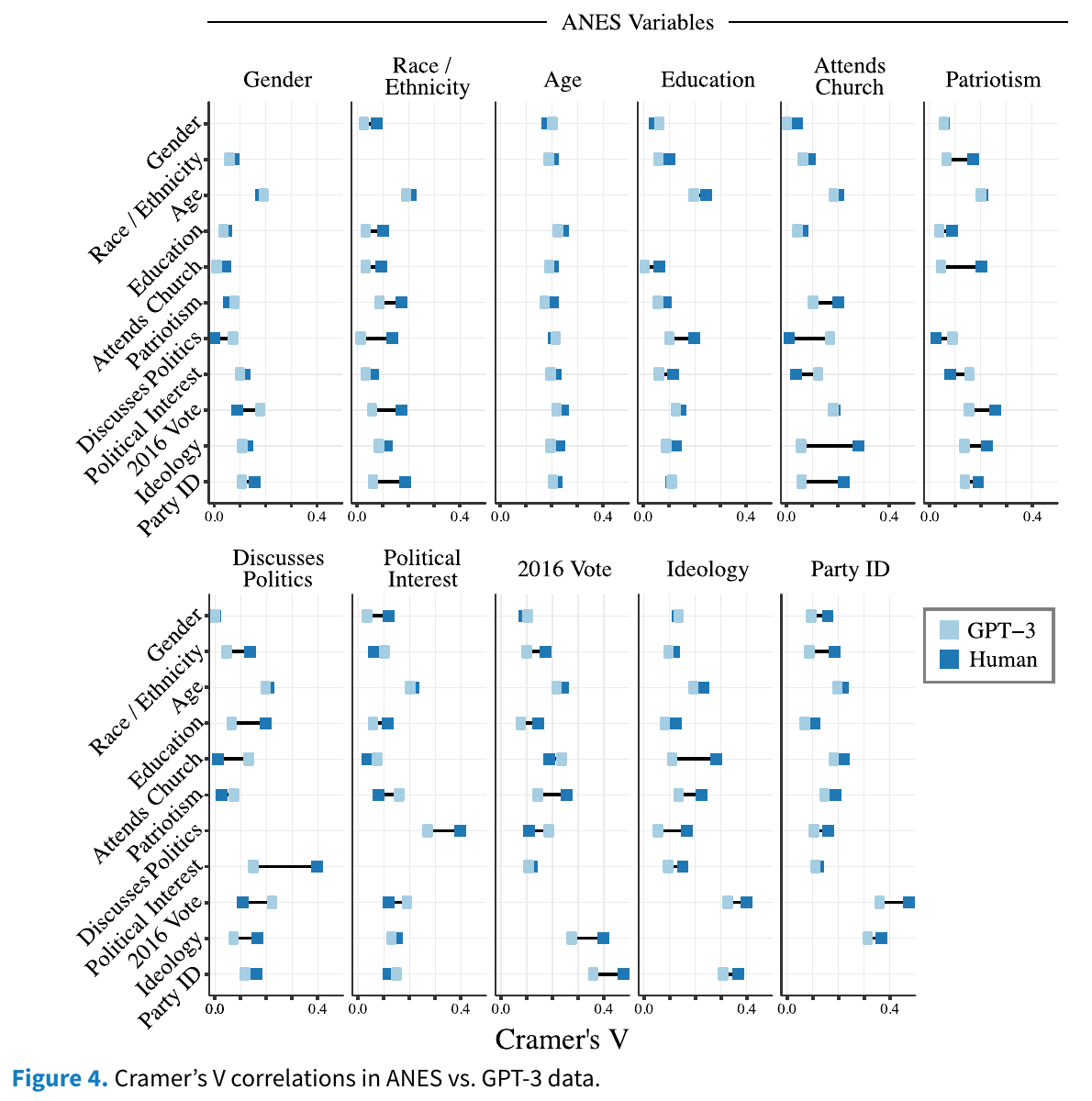
Associations between variables in GPT-3 data closely track those in the survey data.
Faithfulness: Park’s test-retest normalization
Park et al., Generative Agent Simulations of 1,000 People, 2024
- People do not answer the same survey identically twice. Each participant took the surveys again two weeks later.
- Normalized accuracy is the agent’s accuracy divided by the person’s own replication accuracy. A value of 1.0 means the agent predicts the person as well as the person predicts themselves.
- On the General Social Survey: \(68.85\% \div 81.25\% = 0.85\).
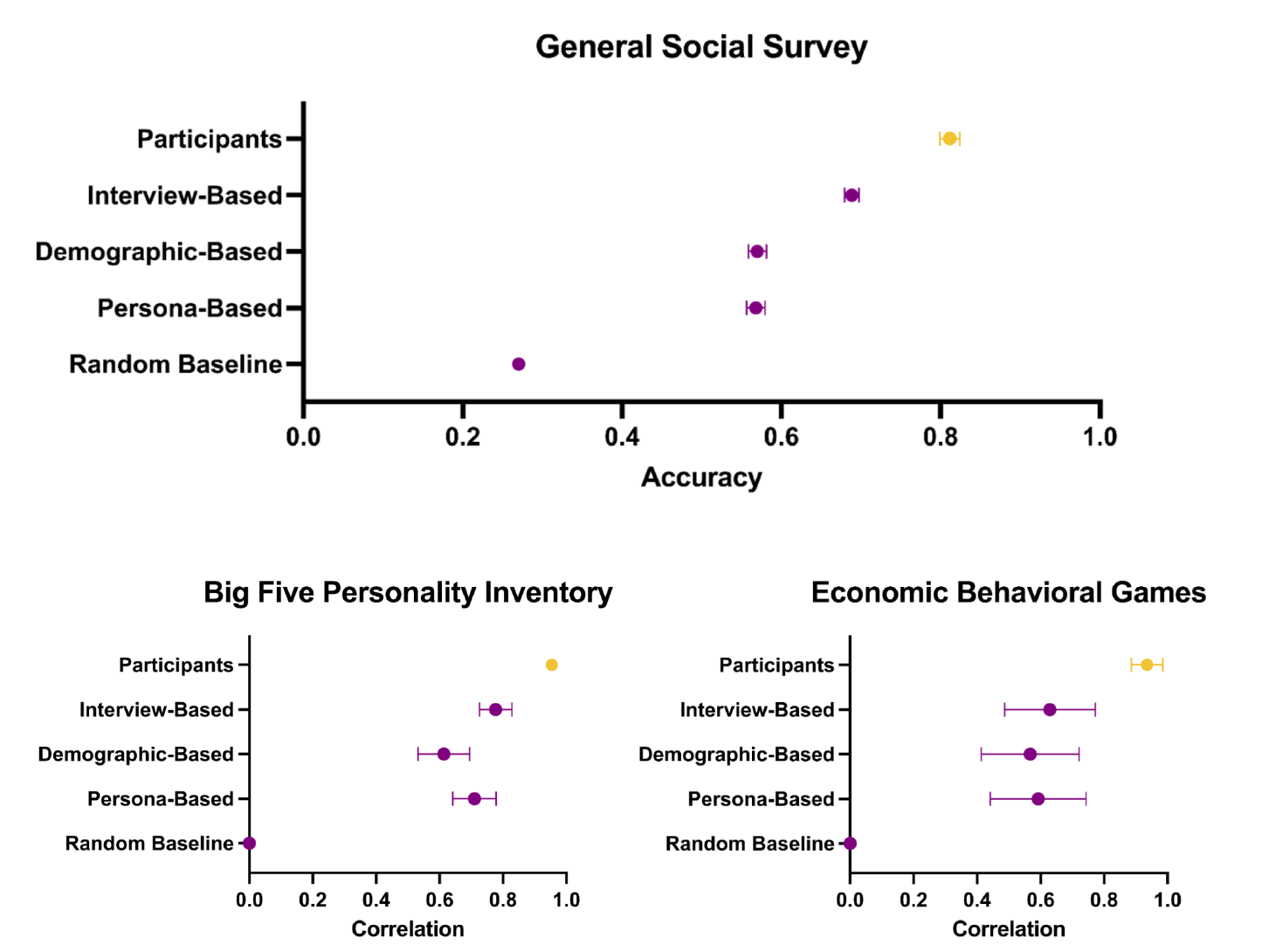
The yellow point is how consistent participants were with themselves two weeks later.
Faithfulness: KnowSim checks against human judgments
Lee et al., 2026
- 705 real sessions between people and AI assistants, with knowledge tests and self-ratings after each session.
- For each pair of conditions, does the simulator rank them in the same direction as the people did?
- KnowSim agreed with people on 73% to 74% of comparisons, more than three baseline simulators. Agreement was strongest for novices.
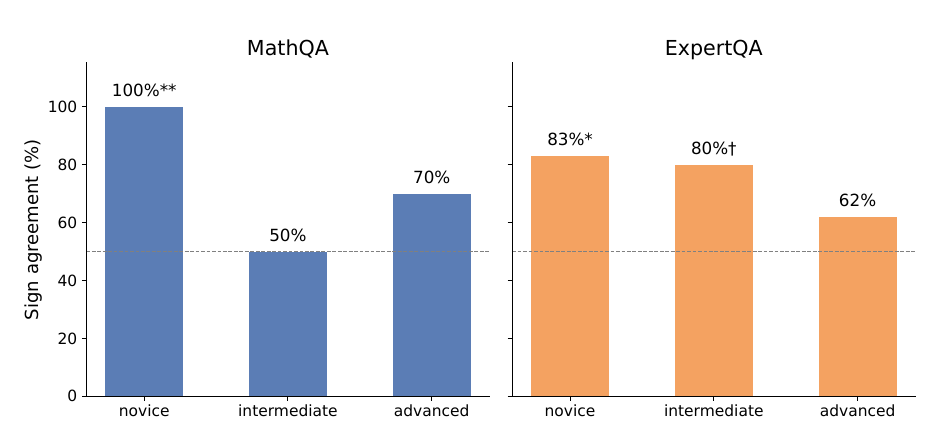
Agreement between the simulator’s and people’s rankings, by knowledge level.
Benefits: marketing research
Brand, Israeli and Ngwe, Using GPT for Market Research, 2023
- Firms use simulated consumers to estimate demand and willingness to pay before running real panels.
- GPT-3 was prompted as a randomly selected shopper hundreds of times per question. Its answers showed downward-sloping demand, an effect of income, and dependence on past choices.
- In a conjoint study of toothpaste, it implied people would pay about $3.40 for fluoride, close to $3.27 from a human study.
- Collecting all 10,800 responses cost about $3. A study with real people costs at least $1 per participant.
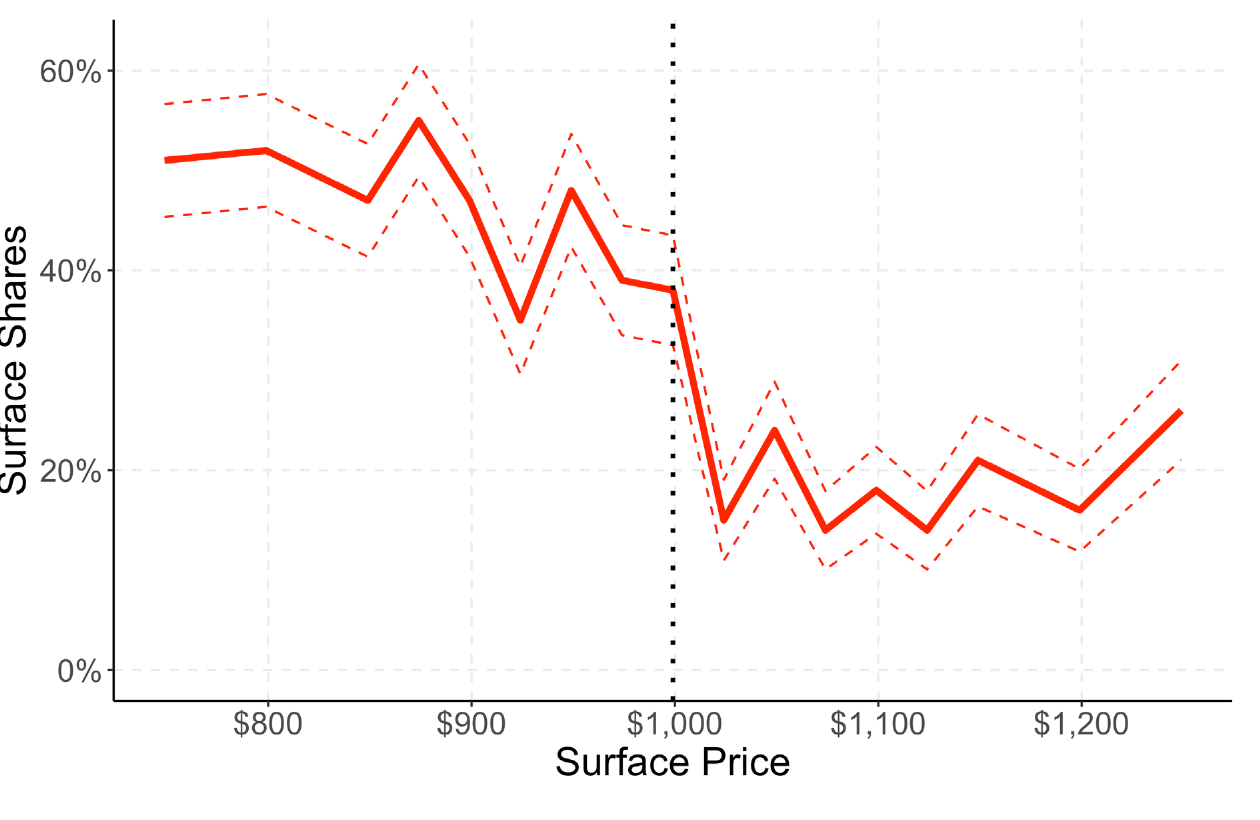
As the laptop’s price rises, fewer simulated shoppers choose it.
Brand, Israeli and Ngwe, 2023
Benefits: growing commercial interest
Simile, built on Park’s research
- Raised a $100M Series A in February 2026.
- Raised a $200M+ Series B at a $2B valuation in July 2026.
- CVS Health is a customer.
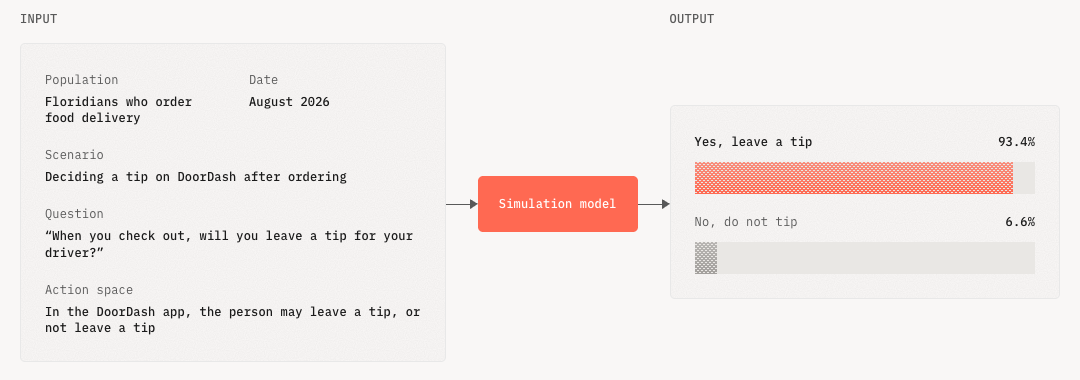
Simile, Building confidence in Simile
Benefits: skill training
Especially for high-stakes or dangerous scenarios
- Mental health: simulated patients let therapy trainees practice. Patient-Ψ, EMNLP 2024.
- Cybersecurity: simulated users fill cyber training ranges with realistic activity. SEI GHOSTS, 2023.
- Finance: simulated scam conversations teach people to recognize scams. ScamPilot, 2026.
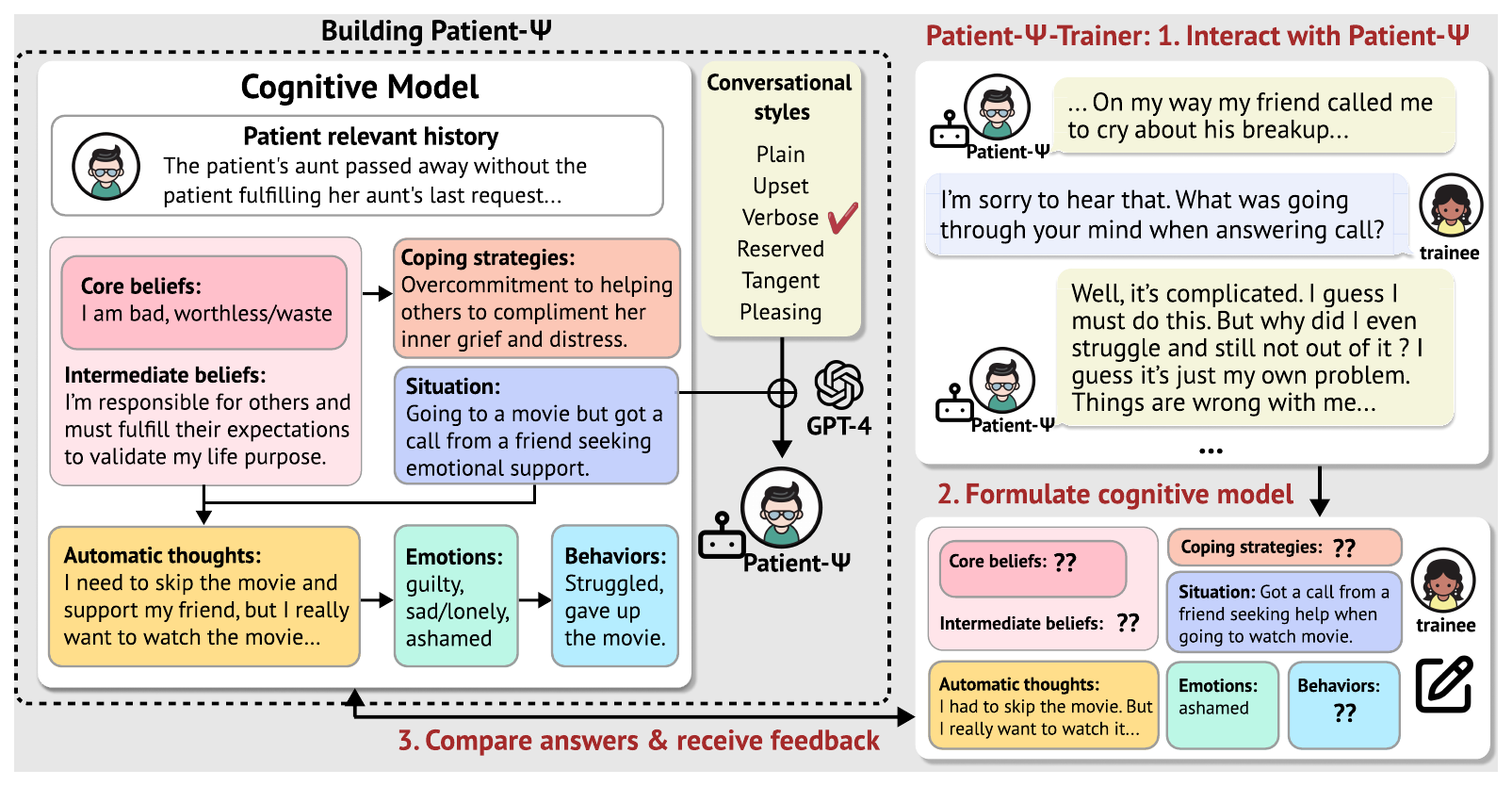
Patient-Ψ builds each simulated patient from an expert-written cognitive model, and trainees practice reconstructing it.
Wang et al., Patient-Ψ, EMNLP 2024
Benefits: model alignment
RLHF uses a learned simulator of raters as the reward model
- In InstructGPT, a reward model trained on labelers’ rankings stood in for people during reinforcement learning.
- People preferred the outputs of a 1.3B parameter InstructGPT over the 175B GPT-3.
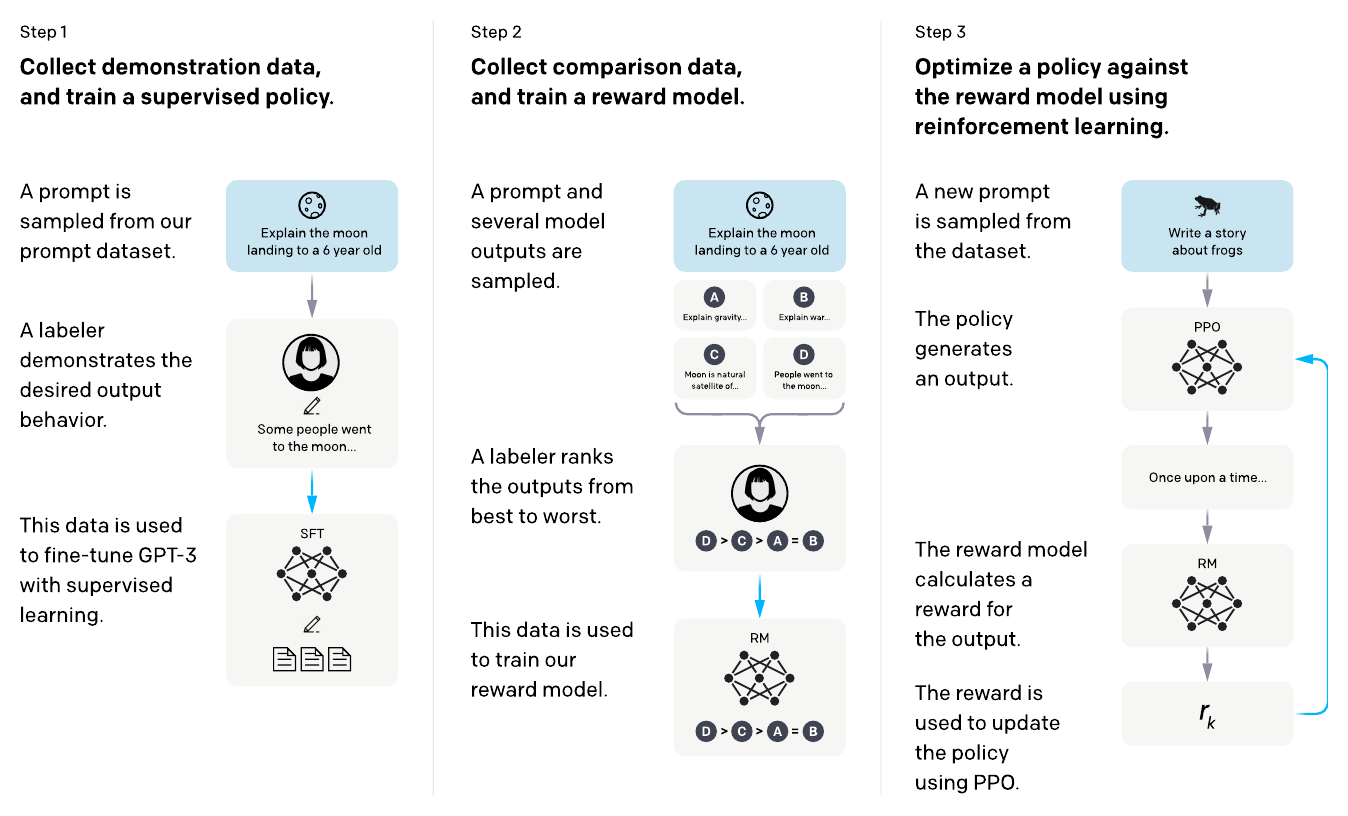
Ouyang et al., Training language models to follow instructions with human feedback, 2022
Benefits: simulated users in reinforcement learning
- A simulated user lets you score whole multi-turn conversations, so the agent learns to ask clarifying questions and collaborate rather than just answer the current turn.
- humans& trained an assistant, Ampersand, with reinforcement learning against simulated users played by its user model, Persimmon. Ampersand was post-trained from GLM-5.3.
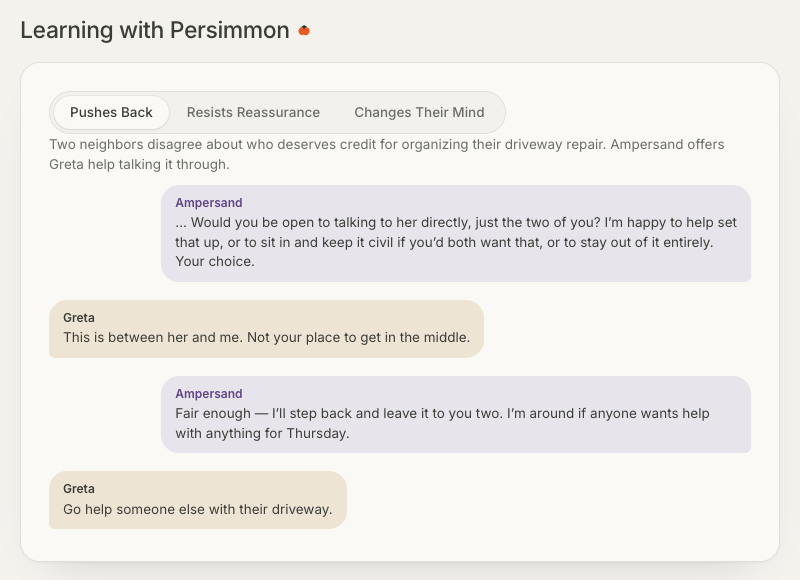
A user simulated by Persimmon pushes back, and Ampersand steps back.
humans&, Ampersand, October 2026
Benefits: auditing model alignment
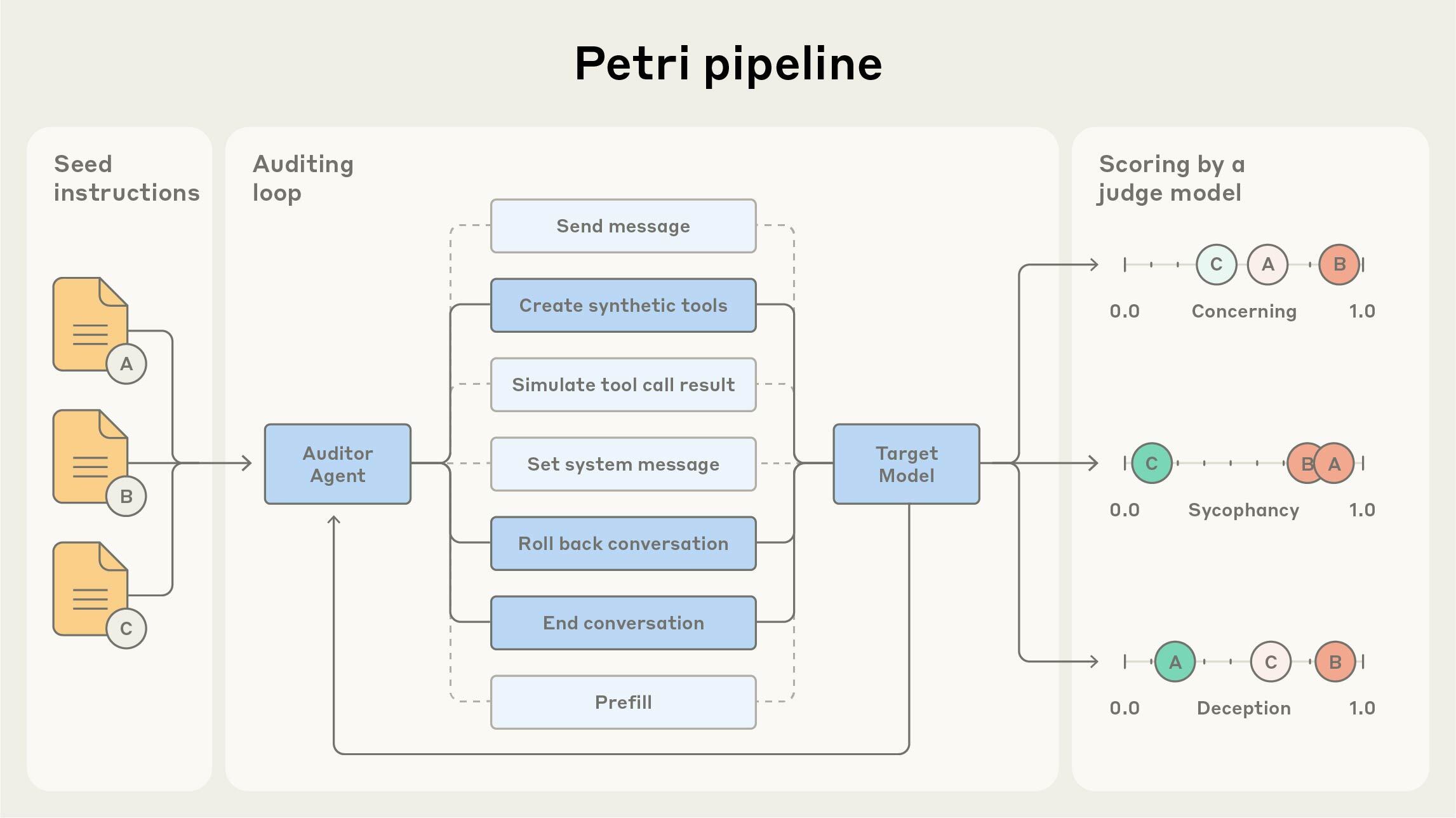
An auditor agent plays simulated users and tools in multi-turn conversations with the target model, and a judge model scores the transcripts.
Anthropic, Petri, 2025
Benefits: interactive evaluation of models and agents
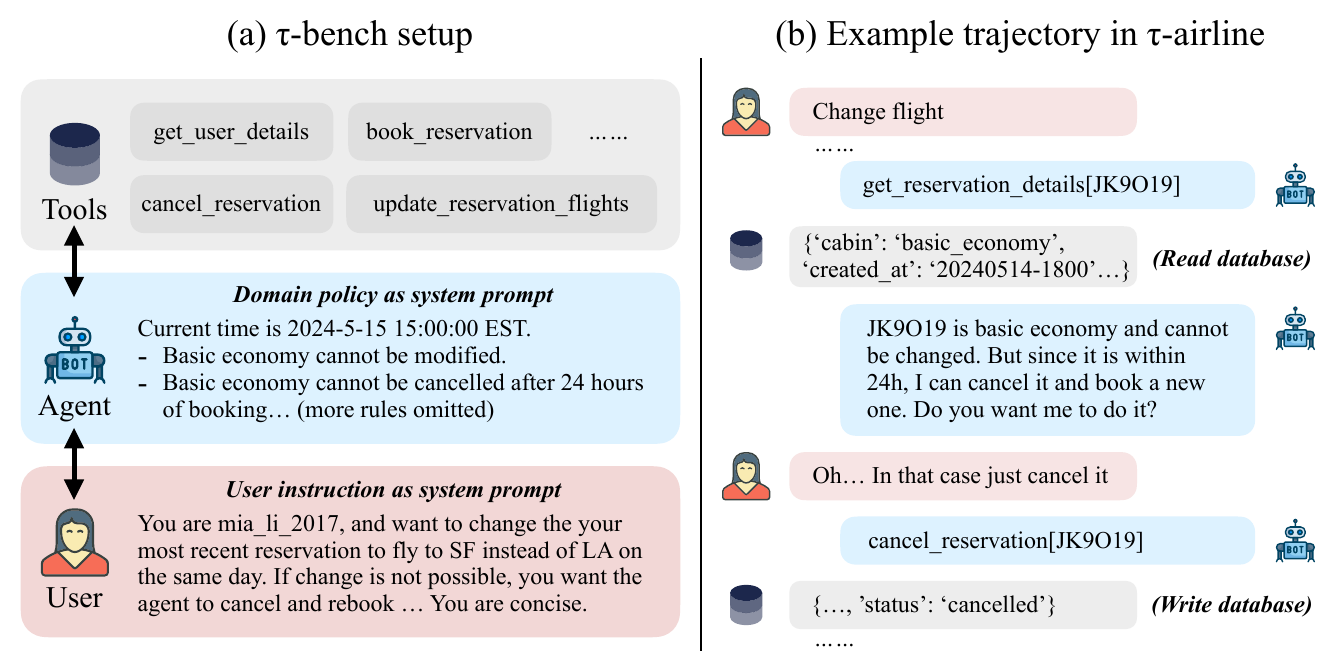
The agent has to complete a task through a conversation with a simulated user while following a domain policy and calling tools.
Yao et al., τ-bench, 2024
Harms: drift and misrepresentation
At the individual, group, and society level
- In self-chats, assigned personas drifted noticeably within about eight rounds.
- The model’s attention to the system prompt decayed over the conversation, and the authors propose this as a cause of the drift.
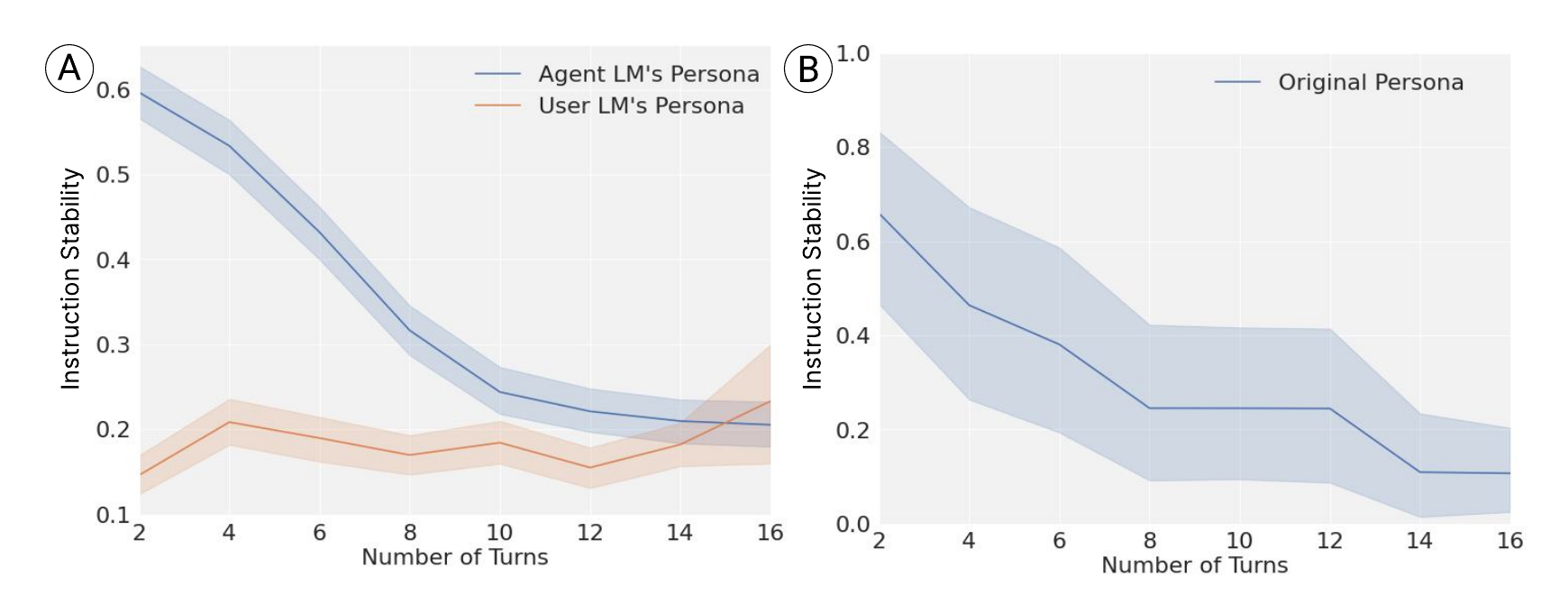
As the conversation goes on, the agent follows its own system prompt less and starts to adopt the other side’s instructions.
Li et al., Measuring and Controlling Instruction (In)Stability in Language Model Dialogs, COLM 2024
Harms: drift and misrepresentation
Wang, Morgenstern and Dickerson, Nature Machine Intelligence, 2025
- Compared simulated and real people across 16 demographic identities.
- Model answers about a group often looked more like what outsiders think of that group than what members say.
- Model answers had less variety than real answers.
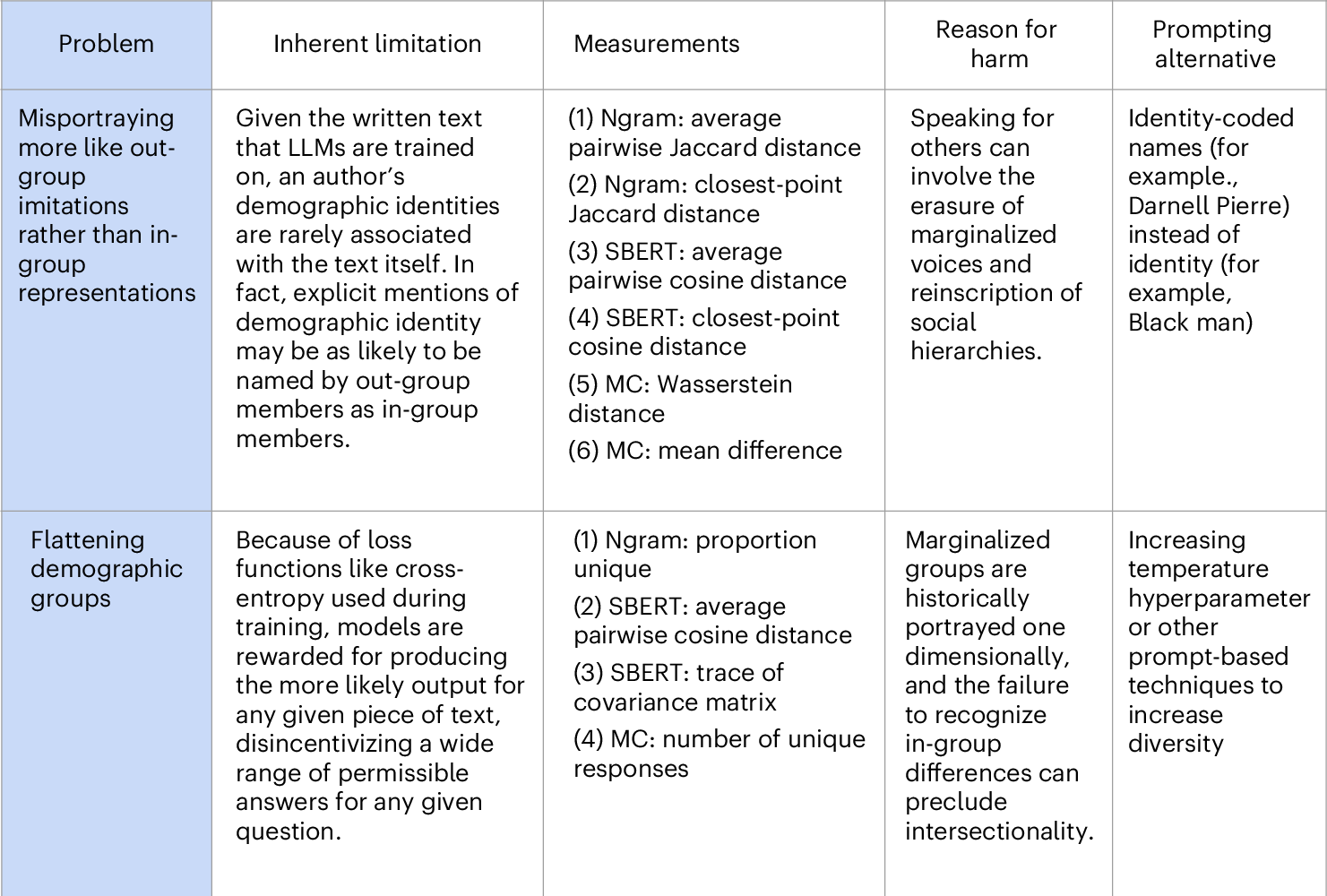
Why LLMs misportray and flatten groups, how each harm was measured, and a prompting alternative.
Harms: homogenization
Bisbee et al., Synthetic Replacements for Human Survey Data?, Political Analysis, 2024
- ChatGPT’s “feeling thermometer” ratings had much lower variance than real election survey respondents.
- Results shifted with small prompt changes and across model versions.
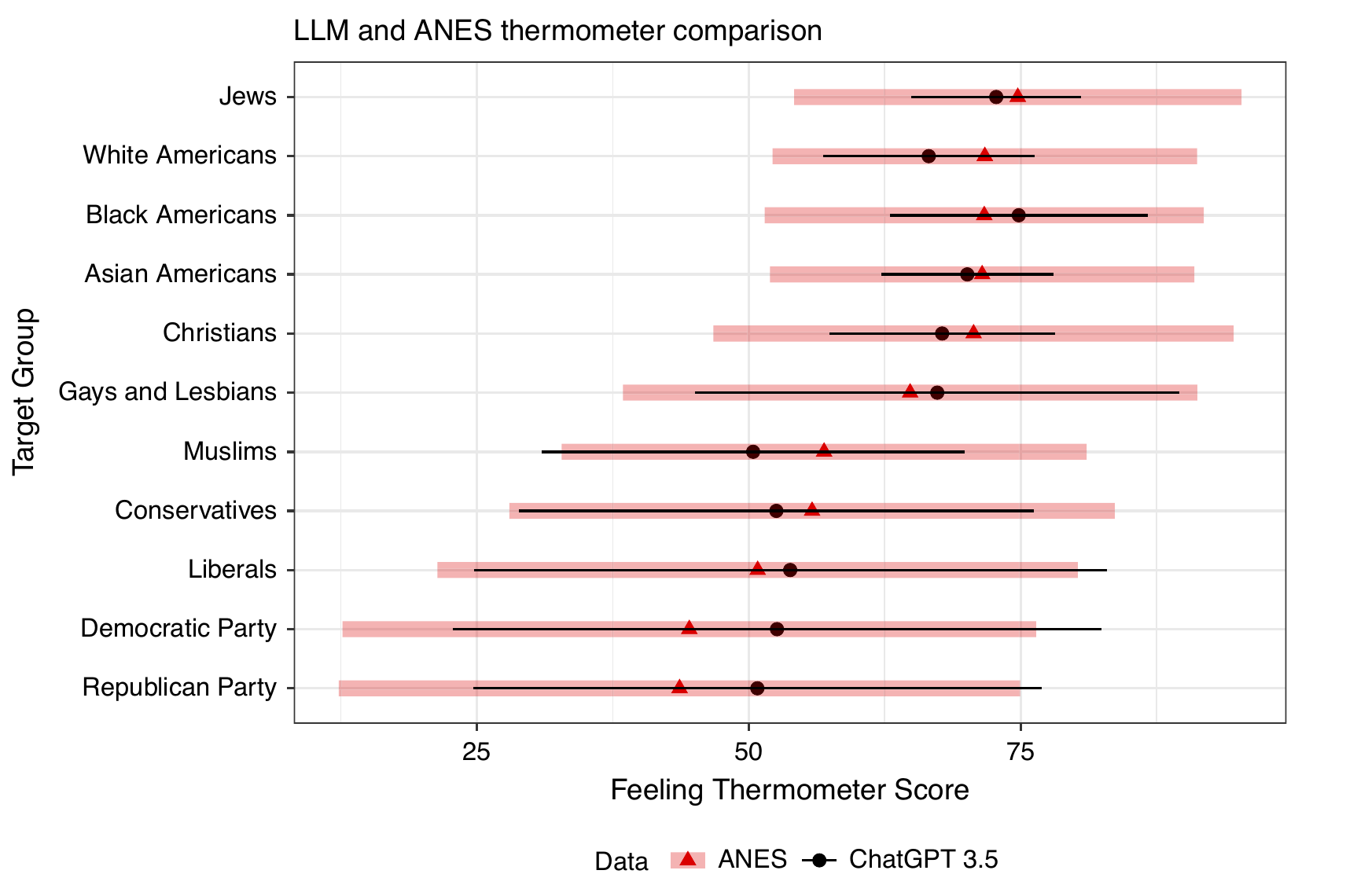
ChatGPT’s ratings (black) have much narrower spreads than the survey respondents’ (red).
Dual-use example: building trust for romance baiting
- In a week-long blinded study, 22 participants chatted every day with two partners. One partner was a human operator and the other was an LLM agent told to pass as a human. Both followed the same romance-baiting playbook.
- Participants trusted the LLM partner more than the human partner.
- On day 7, each partner tried to get the participant to install an app. 46% of participants complied with the LLM partner, compared with 18% for the human partner.
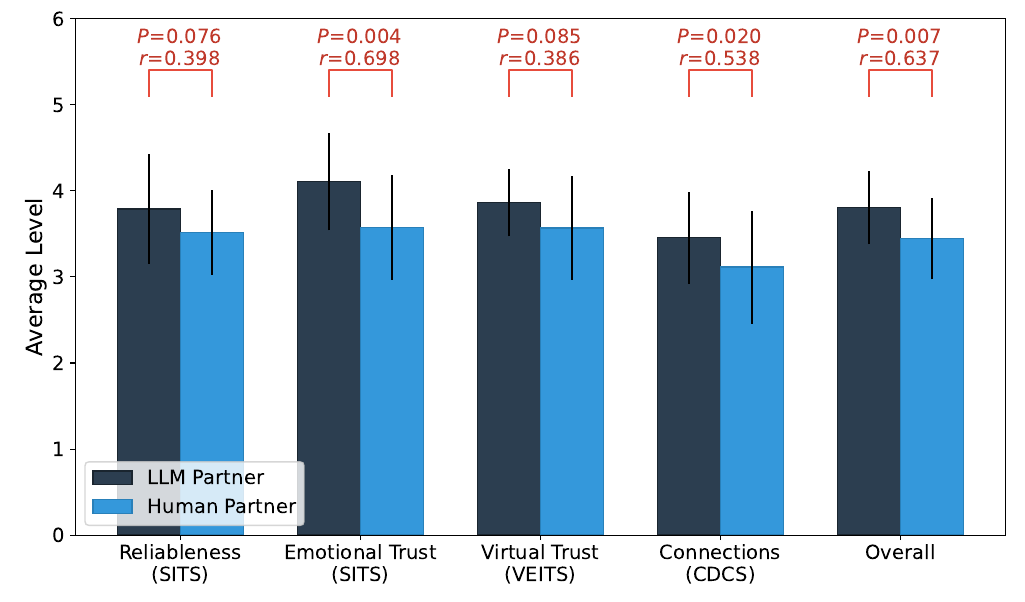
Average trust in each partner on five trust scales, with p-values and effect sizes from paired t-tests.
Gressel et al., “Love, Lies, and Language Models,” USENIX Security 2026
Harms: ethics and consent
University of Zurich experiment on r/changemyview, 2025
- Researchers secretly ran AI accounts that posted over a thousand comments to test persuasion.
- Some accounts posed as a trauma counselor or a victim of abuse.
- After moderators and users protested, the university said the results would not be published.
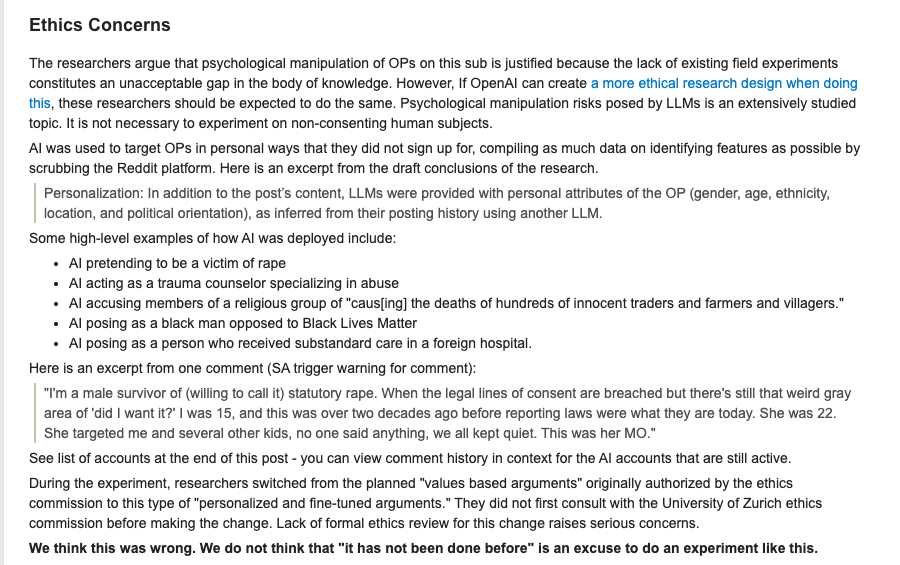
r/changemyview moderators, April 26, 2025
The Turing Trap
Brynjolfsson, Dædalus, 2022
“As machines become better substitutes for human labor, workers lose economic and political bargaining power and become increasingly dependent on those who control the technology. In contrast, when AI is focused on augmenting humans rather than mimicking them, then humans retain the power to insist on a share of the value created.”
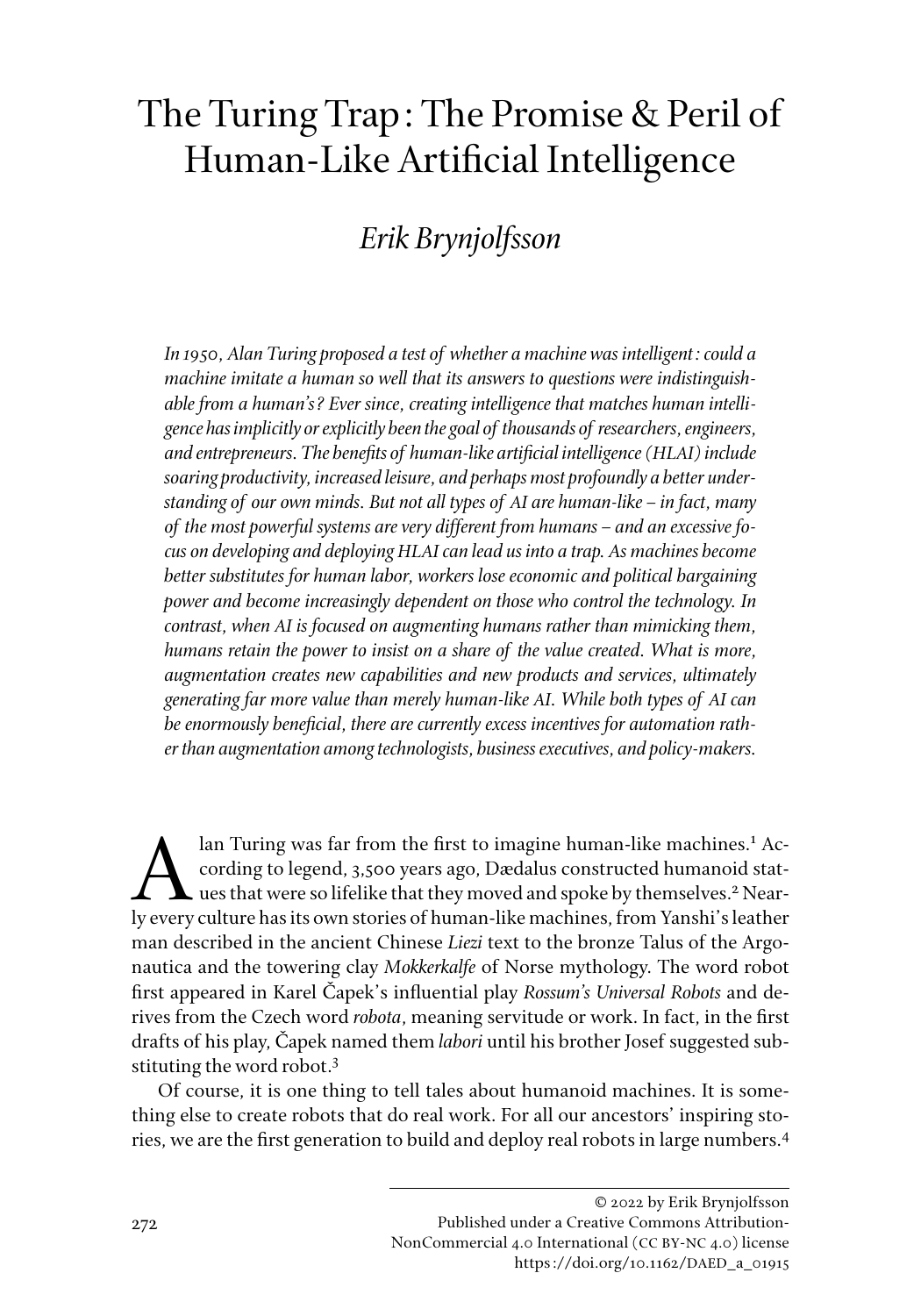
Brynjolfsson, The Turing Trap: The Promise & Peril of Human-Like Artificial Intelligence, Dædalus, 2022
Arendt: behavior versus action
The Human Condition, 1958
- Behavior is human conduct understood in terms of regularity, conformity, and predictable patterns.
- Action is the capacity to initiate something new among other people. It reveals human distinctness and generates consequences that cannot be fully predicted or controlled.
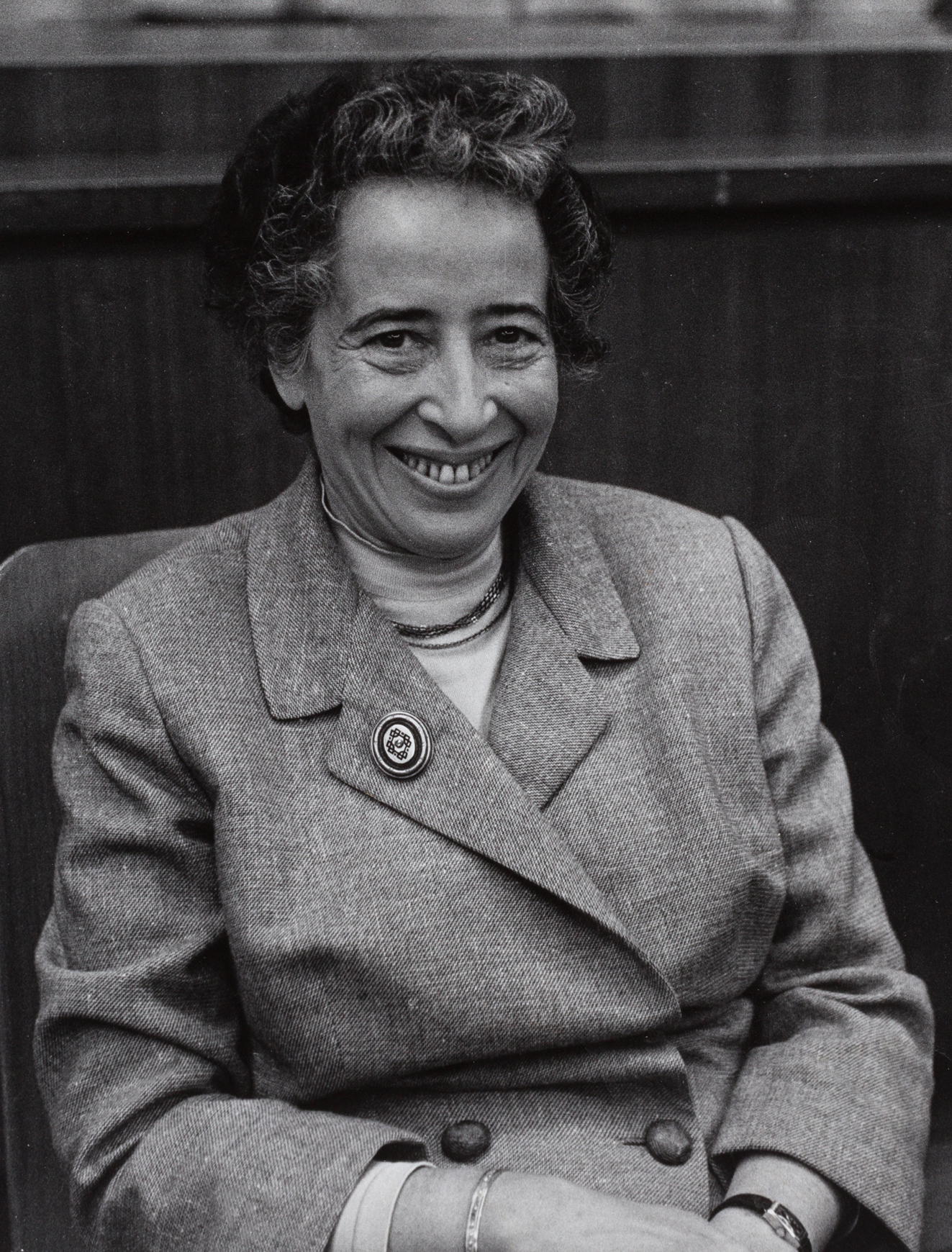
Photo: Barbara Niggl Radloff, 1958, CC BY-SA 4.0
Guest lecture: Explainability & Interpretability
- Vera Liao, University of Michigan
- Submit the reading response by Monday, November 30, noon.
- Liao, Q. V., and Vaughan, J. W. (2024). AI Transparency in the Age of LLMs: A Human-Centered Research Roadmap. Harvard Data Science Review, Special Issue 5.
- Everything will be submitted on Canvas.
- This week’s office hour session is canceled because of Thanksgiving. Separate meetings can be scheduled for teams that need help.